
Alkyd Resins — Industrial & Architectural Alkyd Resin Manufacturer
High-consistency long oil, medium oil, short oil, fast drying, urethane-modified and styrenated alkyd resins engineered for architectural paints, anticorrosive primers, wood varnishes and 2K/stoving systems.
ALKYD FA60 W70
Long-Oil Oxidative Drying Alkyd Resin Based on Soybean Oil Fatty Acid
ALKYD S60 W70
Long-Oil Oxidative Drying Alkyd Resin Based on Soybean Oil
ALKYD S62 W70 LV
Long-Oil Oxidative Drying Alkyd Resin Based on Soybean Oil
ALKYD S64 W70
Long-Oil Oxidative Drying Alkyd Resin Based on Soybean Oil
ALKYD S64 D70
Long-Oil Oxidative Drying Alkyd Resin Based on Soybean Oil
ALKYD S68 W75
Long-Oil Oxidative Drying Alkyd Resin Based on Soybean Oil
ALKYD FA55 W70
Long-Oil Oxidative Drying Alkyd Resin Based on Vegetable Fatty Acid
ALKYD FA55 W70
Long-Oil Oxidative Drying Alkyd Resin Based on Vegetable Fatty Acid
ALKYD FA50 X70
Medium-Oil Air Drying Alkyd Resin Based on Vegetable Fatty Acid
ALKYD FA50 W60
Medium-Oil Air Drying Alkyd Resin Based on Vegetable Fatty Acid
ALKYD FA50 WX55
Medium-Oil Air Drying Alkyd Resin Based on Vegetable Fatty Acid
ALKYD TFA50 WX60
Medium-Oil Air Drying Alkyd Resin Based on Tall Oil Fatty Acid
ALKYD TFA50 X65
Tall Oil Yağ Asidi Bazlı, Orta Yağlı, Hava İle Kuruyan Alkid Reçinesi
ALKYD FA47 WX60
Medium-Oil Air Drying Alkyd Resin Based on Vegetable Fatty Acid
ALKYD FA47 SS50
Medium-Oil Air Drying Alkyd Resin Based on Vegetable Fatty Acid
ALKYD FA38 X65
Short-Oil Alkyd Resin Based on Vegetable Fatty Acid
ALKYD FA43 X65
Short-Oil Alkyd Resin Based on Vegetable Fatty Acid
ALKYD FA43 T65
Short-Oil Alkyd Resin Based on Vegetable Fatty Acid
ALKYD FA29 X65
Short-Oil Alkyd Resin Based on Vegetable Fatty Acid
ALKYD CFA33 BG60
Short-Oil Non-Drying Alkyd Resin Based on Coconut Fatty Acid
ALKYD CO43 X60
Short-Oil Alkyd Resin Based on Castor Oil
ALKYD FA27 X60
Fast Drying Short Oil Alkyd Resin Based on Vegetable Fatty Acid
ALKYD S27 X60
Fast Drying Short Oil Alkyd Resin Based on Soybean Oil
ALKYD FA27 X70
Fast Drying Short Oil Alkyd Resin Based on Vegetable Fatty Acid
ALKYD FA27 T70
Fast Drying Short Oil Alkyd Resin Based on Vegetable Fatty Acid
ALKYD S27 X70
Fast Drying Short Oil Alkyd Resin Based on Soybean Oil
ALKYD S38 X60
Fast Drying Short Oil Alkyd Resin Based on Soybean Oil
ALKYD FA31 X60
Fast Drying Short Oil Alkyd Resin Based on Vegetable Fatty Acid
ALKYD CFA31 X60 PU
Short Oil Alkyd Resin Based on Coconut Fatty Acid
ALKYD CFA30 X70 PU
Short Oil Alkyd Resin Based on Coconut Fatty Acid
ALKYD FA38 X60 PU
Vegetable Fatty Acid Based Short Oil Alkyd Resin Modified with Aromatic Isocyanates
ALKYD S25 X45 PU
Soybean Oil Based Short Oil Alkyd Resin Modified with Aromatic Isocyanates
ALKYD FA54 W60 UR
Air Drying Urethane Modified Medium-Oil Alkyd Resin Based on Vegetable Fatty Acid
ALKYD FA60 W60 UR
Air Drying Aliphatic Isocyanate Modified Long-Oil Alkyd Resin Based on Vegetable Fatty Acid
ALKYD FA60 D60 UR
Air Drying Aliphatic Isocyanate Modified Long-Oil Alkyd Resin Based on Vegetable Fatty Acid
ALKYD S62 W55 UR
Air Drying Urethane Modified Long-Oil Alkyd Resin Based on Soybean Oil
ALKYD S62 D58 UR
Air Drying Aromatic Isocyanate Modified Long-Oil Alkyd Resin Based on Soybean Oil
ALKYD FA25 X60 ST
Styrenated Short Oil Alkyd Resin Based on Vegetable Fatty Acid
ALKYD DCO31 X60 STAC
Styrene & Acrylic Modified Short Oil Alkyd Resin Based on Dehydrated Castor Oil Fatty Acid
ALKYD TFA30 X60 ST
Styrenated Short Oil Alkyd Resin Based on Tall Oil Fatty Acid
ALKYD S40 X60 ST
Styrenated Short Oil Alkyd Resin Based on Soybean Oil
What Is Alkyd Resin? Manufacturing Technology & Coating Performance
Alkyd resin is a polyester-based synthetic binder synthesized via high-temperature azeotropic polycondensation of polyhydric alcohols (pentaerythritol, glycerol), polybasic acids or anhydrides (phthalic anhydride), and fatty acids or triglyceride oils (soybean oil, tall oil fatty acid [TOFA], coconut oil, castor oil, dehydrated castor oil [DCO]). It remains the most versatile workhorse binder across decorative architectural paints, industrial protective coatings, and wood finishes.
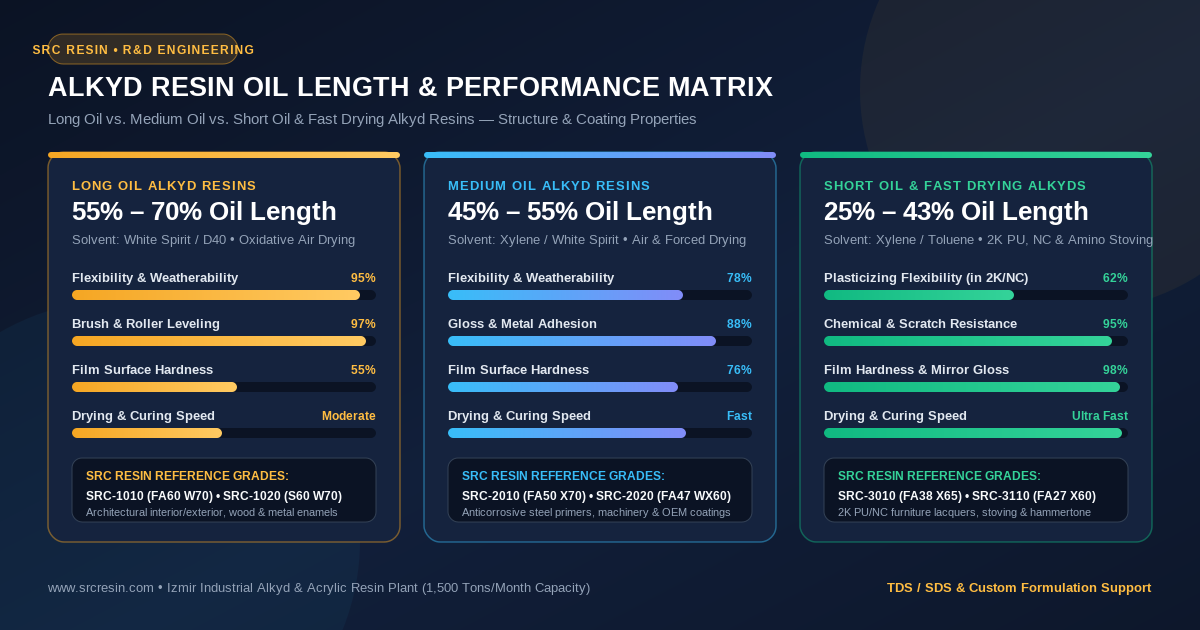
The percentage of fatty acid/oil in the polymer backbone (Oil Length) directly governs solvent compatibility, curing mechanism, film hardness, elasticity, and yellowing resistance. Long oil alkyd resins (55–70% oil) dissolve in aliphatic hydrocarbon solvents (White Spirit, D40) and cure by atmospheric autoxidation; medium oil alkyds (45–55% oil) balance rapid drying with corrosion protection in industrial primers and machinery enamels. Short oil (25–43%) and fast-drying alkyd resins dissolve in aromatic solvents (Xylene, Toluene) to deliver high crosslink density in 2K polyurethane wood coatings, nitrocellulose (NC) lacquers, amino/melamine stoving enamels, and rapid-cure industrial metal finishes.
At SRC Resin’s 1,500 tons/month manufacturing plant in Izmir, Türkiye, we engineer standard and modified (urethane, polyurethane, styrene, benzoic acid) alkyd resins under strict reactor control—ensuring narrow molecular weight distribution (Mw/Mn), low Gardner color, controlled acid value (mg KOH/g), and batch-to-batch viscosity consistency.
4 Critical Engineering Parameters When Selecting an Alkyd Resin
Determines oxidative drying speed, film flexibility, solvent polarity, and non-yellowing color stability.
Governs crosslink density, chemical resistance, and hardness in 2K polyurethane (NCO) and amino stoving systems.
Optimizes pigment wetting, dispersion stability, metal substrate adhesion, and in-can storage shelf life.
Controls brush/spray application rheology, leveling, sag resistance, and tack-free drying time.
Long Oil vs. Medium Oil vs. Short Oil & Modified Alkyd Resins Comparison Table
Compare SRC Resin’s alkyd resin families by oil length, curing mechanism, solvent system, and coating performance.
| Alkyd Resin Group | Oil Length (%) | Curing / Drying Mechanism | Typical Solvents | Film Hardness, Flexibility & Gloss | Primary Coating Applications | Representative SRC Grades |
|---|---|---|---|---|---|---|
| Long Oil Alkyd Resins | 55% – 70% | Oxidative Air Drying (with Co/Zr/Ca Driers) | White Spirit, D40 | Superior elasticity, excellent brushability & leveling, high gloss retention, outdoor weatherability | Interior & exterior architectural enamels, decorative wood & metal topcoats, synthetic undercoats | |
| Medium Oil Alkyd Resins | 45% – 55% | Oxidative Air Drying & Forced Drying | Xylene, White Spirit / Xylene | Balanced flexibility and film hardness, strong metal adhesion, water & corrosion resistance | Anticorrosive metal primers, industrial machinery paints, agricultural equipment & auto-repair finishes | |
| Short Oil Alkyd Resins | 28% – 43% | 2K Polyurethane (NCO), Amino Stoving & NC Plasticizing | Xylene, Toluene, Butyl Glycol / Sol 100 | High OH% (2.8–4.0%), maximum surface hardness, chemical resistance, high gloss & non-yellowing | 2K PU & nitrocellulose (NC) furniture lacquers, industrial stoving enamels, can & coil coatings | |
| Fast Drying Alkyd Resins | 27% – 38% | Benzoic Acid Modified Rapid Physical + Oxidative Curing | Xylene, Toluene | 10–20 min dust-free drying, early handling & stacking, high hardness and safe recoat window | Very fast-drying industrial primers & topcoats, hammertone paints, road marking coatings | |
| Urethane & Polyurethane Modified Alkyds | 25% – 62% | 1K Oxidative (Aromatic/Aliphatic Uralkyd) or 2K Isocyanate Curing | White Spirit, D40, Xylene | Superior abrasion, impact & water resistance; non-yellowing aliphatic option (SRC-4120) | Marine yacht varnishes, parquet floor varnishes, furniture sealers, high-gloss 2K PU topcoats | |
| Styrene Modified Alkyd Resins | 25% – 40% | Ultra-Fast Solvent Release + Oxidative Crosslinking | Xylene | Ultra-fast tack-free drying, high early hardness, strong metal adhesion & moisture barrier | High-throughput steel structure primers, hammertone effect finishes, industrial OEM enamels |
R&D Technical Articles on Alkyd Resin Chemistry
Explore in-depth formulation guides authored by our polymer engineering team.
Why Is Molecular Weight Critical in Alkyd Resins?
Molecular weight in alkyd resins directly affects viscosity, application behavior and coating performance. Achieving the right balance between low and high molecular weight is critical for consistent product quality and optimal film properties.
What Does Viscosity Affect in Alkyd Resins?
Its Role in Production Quality and Coating Performance In alkyd resin production, viscosity is often treated as a simple quality control parameter. However, in reality, viscosity is a critical factor that directly influences both the manufacturing process and the final coating performance. An alkyd resin with an incorrect viscosity range can lead to application issues, surface defects and inconsistent film properties. What Is Viscosity in Alkyd Resins? Viscosity is the resistance of a liquid to flow. In alkyd resins, viscosity is influenced by: Molecular weight Solid content Solvent type Resin structure Each of these parameters plays a role in defining how the resin behaves during application. Key Factors That Determine Viscosity 1. Molecular Weight As molecular weight increases, viscosity increases. This typically results in: Higher film strength More difficult application Balancing molecular weight is essential for optimal performance. 2. Solid Content Higher solid content leads to higher viscosity. This means: Lower solvent levels More concentrated resin structure High-solid systems are often preferred for performance, but require careful viscosity control. 3. Solvent System The type of solvent used significantly affects viscosity. The same resin may behave differently depending on the solvent system, influencing flow, leveling and application properties. How Does Viscosity Affect Application? Viscosity is not just a lab value. It directly impacts real-world application: Ease of application Flow and leveling Brush and roller marks Film thickness control Surface smoothness Incorrect viscosity often results in poor surface quality. Viscosity and Film Performance Viscosity also affects the final film properties: Too low viscosity → weak film, low durability Too high viscosity → poor leveling, surface defects The goal is to achieve the correct balance between application and performance. Conclusion from a Manufacturer’s Perspective In alkyd resins, viscosity is not just a measurement—it is a defining characteristic of the product. Proper viscosity control: Improves process efficiency Enhances application behavior Ensures consistent coating performance For this reason, viscosity should be considered as critical as formulation design.
Why Do Alkyd Resins Yellow?
Yellowing in alkyd resins is influenced by fatty acid structure, curing mechanism, drier balance and environmental exposure. In light-colored coatings, color stability is a critical performance factor. This article explains the technical causes of yellowing in alkyd systems and outlines how proper resin selection and curing design can minimize discoloration.
Differences Between Fast Drying Alkyd Resins and Non-Drying Alkyd Resins
Fast drying and non-drying alkyd resins are designed for different curing mechanisms in industrial coating systems. While fast drying alkyds cure by air oxidation, non-drying alkyds require controlled curing such as oven or catalytic systems. This article explains the key differences between fast drying and non-drying alkyd resins and provides guidance on selecting the correct system for industrial applications.
What Is a Non-Drying Short Oil Alkyd Resin?
Non-drying short oil alkyd resins are developed for industrial coating applications where air drying is not sufficient or not desired. These resins do not cure by oxidation alone, but instead require controlled curing systems such as amino resins or polyurethane crosslinkers. This article explains where non-drying short oil alkyd resins are used, their key advantages, and how SRC-3040 (ALKYD CFA33 BG60) fits into oven-cured and high chemical resistance coating systems from a manufacturer’s perspective.
What Is a Fast Drying Alkyd Resin?
Fast drying alkyd resins are developed to minimize drying time while maintaining high film performance in industrial coating applications. Short oil alkyd systems offer rapid curing, high gloss and balanced mechanical properties. This article explains where fast drying alkyd resins are used, their advantages, and how SRC-3110 (ALKYD FA27 X60) fits into this category as a reliable solution for high-speed industrial coatings.
TECHNICAL FAQ
Frequently Asked Questions About Alkyd Resins
The core difference is the weight percentage of fatty acid/triglyceride oil in the resin backbone (Oil Length). Long oil alkyds (55–70% oil) dissolve in aliphatic White Spirit, cure by air oxidation, and provide high flexibility and brushability for architectural paints (e.g., SRC-1010, SRC-1020). Medium oil alkyds (45–55% oil) offer faster drying and durability for anticorrosive metal primers and machinery coats (e.g., SRC-2010). Short oil alkyds (25–43% oil) dissolve in Xylene/Toluene and feature high hydroxyl (OH%) functionality for 2K polyurethane, nitrocellulose (NC), and amino stoving systems (e.g., SRC-3010, SRC-3040).
Yellowing is primarily triggered by oxidation of conjugated and tri-unsaturated fatty acids (such as linolenic acid). For non-yellowing 2K polyurethane and stoving white enamels, saturated Coconut fatty acid-based short oil alkyds (SRC-3040, SRC-4010, SRC-4020) deliver maximum color stability. For 1K air-drying clear marine and wood varnishes, our aliphatic isocyanate-modified urethane alkyds (SRC-4120 and SRC-4121) are specifically engineered for non-yellowing UV durability.
Fast Drying Alkyd Resins (SRC-3110 to SRC-3130) use benzoic acid chain-stopping modification to achieve rapid 15–20 minute dust-free drying while maintaining a safe recoat window and strong through-cure. Styrene Modified Alkyds (SRC-4210 to SRC-4240) dry by ultra-fast solvent evaporation within minutes and are ideal for high-speed structural steel primers and hammertone finishes.
For 2K polyurethane wood coatings cured with polyisocyanate hardeners, high-OH short oil and PU-modified alkyds are required: SRC-4030 (5.30% OH) for high-build easy-sanding furniture sealers, SRC-4020 (4.20% OH) for high-gloss topcoats, and SRC-3010 / SRC-3020 (2.90% OH) for versatile 2K PU and nitrocellulose (NC) wood finishes.
Yes. With a 1,500 tons/month capacity in Izmir, Türkiye, our R&D team customizes solid content (NVM %), viscosity, solvent cut, and oil type to match your exact plant requirements. We supply lab samples, TDS/SDS documentation, and export globally in steel drums, IBC totes, or bulk isotanks via our Aliağa and Gebze logistics hubs.
Let's Select the Optimal Alkyd or Acrylic Resin for Your Formulation
Our R&D engineering team provides laboratory samples, TDS/SDS documentation, and custom viscosity or solids adjustments.
Request Quote & Sample