Factors Affecting Color Stability in Industrial Coatings
Alkyd resins are widely used in both decorative and industrial coatings due to their gloss, workability and cost efficiency. However, one of the most common issues—especially in light-colored systems—is yellowing.
Yellowing is not just an aesthetic problem. It directly affects product perception, quality consistency and long-term performance. Understanding the mechanism behind yellowing in alkyd systems is essential for selecting the correct resin and curing strategy.
What Is Yellowing in Alkyd Resins?
Yellowing refers to the gradual color change of the coating film over time. A film that initially appears clear or light may shift toward yellow tones due to chemical changes occurring within the resin structure.
This phenomenon is typically related to
Oxidative reactions
Heat exposure
Improper curing mechanisms
Fatty acid structure
Imbalanced drier systems
Key Factors That Influence Yellowing
- Fatty Acid Structure
The type and level of unsaturation in the fatty acids used in alkyd resin production significantly influence yellowing tendency.
Higher unsaturation → increased oxidation potential → greater risk of yellowing.
Resins based on more stable fatty acid structures generally show better color stability.
- Curing Mechanism
Oxidatively curing alkyd systems may continue low-level reactions even after film formation. Over time, this ongoing oxidation can cause discoloration.
In contrast, oven-cured or crosslinked systems (such as amino or polyurethane systems) typically provide more stable curing and improved long-term color performance.
- Drier Selection and Balance
Incorrect drier combinations can result in
Uneven curing
Localized oxidation
Increased long-term yellowing
Simply increasing drier dosage is not a solution. A balanced and compatible system is required.
- Heat and UV Exposure
High temperatures and UV radiation accelerate oxidation processes. In applications exposed to heat or sunlight, yellowing tendency can increase significantly.
Service conditions must always be considered when designing alkyd systems.
How to Minimize Yellowing
To reduce yellowing risk
Select alkyd resins with low yellowing tendency
Choose the appropriate curing mechanism
Optimize the drier system
Evaluate application and service conditions
In applications where color stability is critical, resin selection is as important as mechanical performance.
Conclusion
Yellowing in alkyd resins is not caused by a single factor. It is the result of fatty acid structure, curing mechanism, drier balance and environmental exposure.
For long-term color stability, it is essential to evaluate not only drying speed, but also the chemical balance of the entire alkyd system.
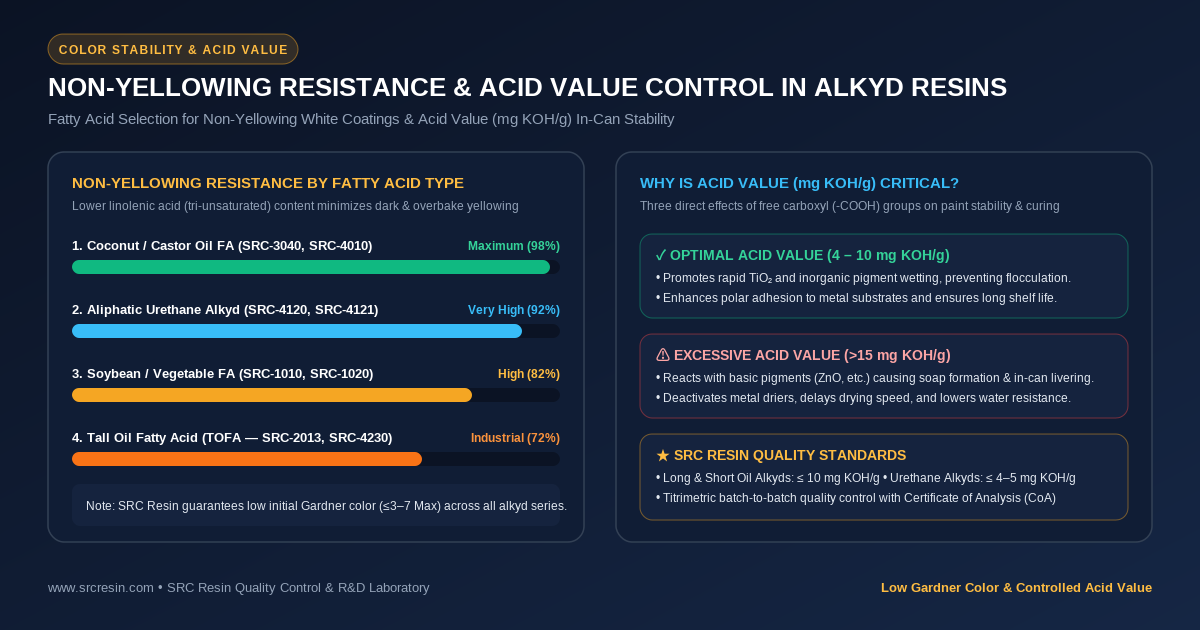
Fatty Acid Type & Acid Value vs. Non-Yellowing Stability Table
Selection guide for white architectural enamels, 2K furniture lacquers, and clear marine varnishes.
| Fatty Acid / Modification | Linolenic Acid Content | Non-Yellowing Resistance | Acid Value (mg KOH/g) | Recommended SRC Grades |
|---|---|---|---|---|
| Coconut Oil Fatty Acid | 0% (Fully Saturated) | Maximum (2K PU & Stoving Whites) | ≤ 10 Max | SRC-3040, SRC-4010, SRC-4020 |
| Aliphatic Isocyanate Urethane Alkyd | Low | Very High (1K Clear Yacht & Wood Varnish) | ≤ 5 Max | SRC-4120, SRC-4121 |
| Soybean / Distilled Vegetable FA | Low-Moderate (~5–7%) | High (Interior/Exterior Decorative White) | ≤ 10 Max | SRC-1010, SRC-1020, SRC-1040 |
| TOFA (Tall Oil Fatty Acid) | Low | Good (Industrial Primers & Machinery) | ≤ 10–13 Max | SRC-2013, SRC-4230 |
Recommended SRC Alkyd Resin Products for This Application
Explore our industrial alkyd resin grades manufactured at our 1,500 tons/month Izmir plant, engineered to meet the technical parameters discussed in this guide:
ALKYD CFA30 X70 PU (Non-Yellowing 2K PU)
Coconut-based PU-modified alkyd delivering maximum whiteness retention in high-gloss 2K furniture topcoats.
ALKYD FA60 W60 UR (Aliphatic Uralkyd)
Non-yellowing aliphatic urethane alkyd designed for marine yacht varnishes and clear wood finishes.
ALKYD CFA33 BG60 (Coconut Short Oil)
High-reactivity non-yellowing short oil alkyd for can coatings, amino stoving enamels, and 2K PU systems.
Frequently Asked Engineering Questions
Why do alkyd paints yellow in dark or indoor environments?
During oxidative crosslinking, polyunsaturated fatty acid chains (especially tri-unsaturated linolenic acid) form hydroperoxides that decompose into yellow chromophoric diketones and quinones. Without UV daylight bleaching, this chromophore buildup appears as dark yellowing.
What happens if the Acid Value (mg KOH/g) of an alkyd resin is too high?
An excessive acid value (>15 mg KOH/g) causes soap formation with basic pigments such as Zinc Oxide (ZnO), resulting in severe viscosity drift or in-can gelation (livering), delayed drying due to drier adsorption, and reduced water resistance.
Which SRC Resin grades are engineered for non-yellowing white lacquers and clear coats?
For 2K polyurethane white furniture topcoats, Coconut fatty acid-based SRC-4010 and SRC-4020 (Gardner Color ≤ 3) offer complete non-yellowing stability. For 1K air-drying clear yacht varnishes, aliphatic isocyanate-modified SRC-4120 and SRC-4121 are ideal.