
Its Role in Production Quality and Coating Performance
In alkyd resin production, viscosity is often treated as a simple quality control parameter. However, in reality, viscosity is a critical factor that directly influences both the manufacturing process and the final coating performance.
An alkyd resin with an incorrect viscosity range can lead to application issues, surface defects and inconsistent film properties.
What Is Viscosity in Alkyd Resins?
Viscosity is the resistance of a liquid to flow. In alkyd resins, viscosity is influenced by:
Molecular weight
Solid content
Solvent type
Resin structure
Each of these parameters plays a role in defining how the resin behaves during application.
Key Factors That Determine Viscosity
- Molecular Weight
As molecular weight increases, viscosity increases.
This typically results in
Higher film strength
More difficult application
Balancing molecular weight is essential for optimal performance.
- Solid Content
Higher solid content leads to higher viscosity.
This means
Lower solvent levels
More concentrated resin structure
High-solid systems are often preferred for performance, but require careful viscosity control.
- Solvent System
The type of solvent used significantly affects viscosity.
The same resin may behave differently depending on the solvent system, influencing flow, leveling and application properties.
How Does Viscosity Affect Application?
Viscosity is not just a lab value. It directly impacts real-world application
Ease of application
Flow and leveling
Brush and roller marks
Film thickness control
Surface smoothness
Incorrect viscosity often results in poor surface quality.
Viscosity and Film Performance
Viscosity also affects the final film properties
Too low viscosity → weak film, low durability
Too high viscosity → poor leveling, surface defects
The goal is to achieve the correct balance between application and performance.
Conclusion from a Manufacturer’s Perspective
In alkyd resins, viscosity is not just a measurement—it is a defining characteristic of the product.
Proper viscosity control
Improves process efficiency
Enhances application behavior
Ensures consistent coating performance
For this reason, viscosity should be considered as critical as formulation design.
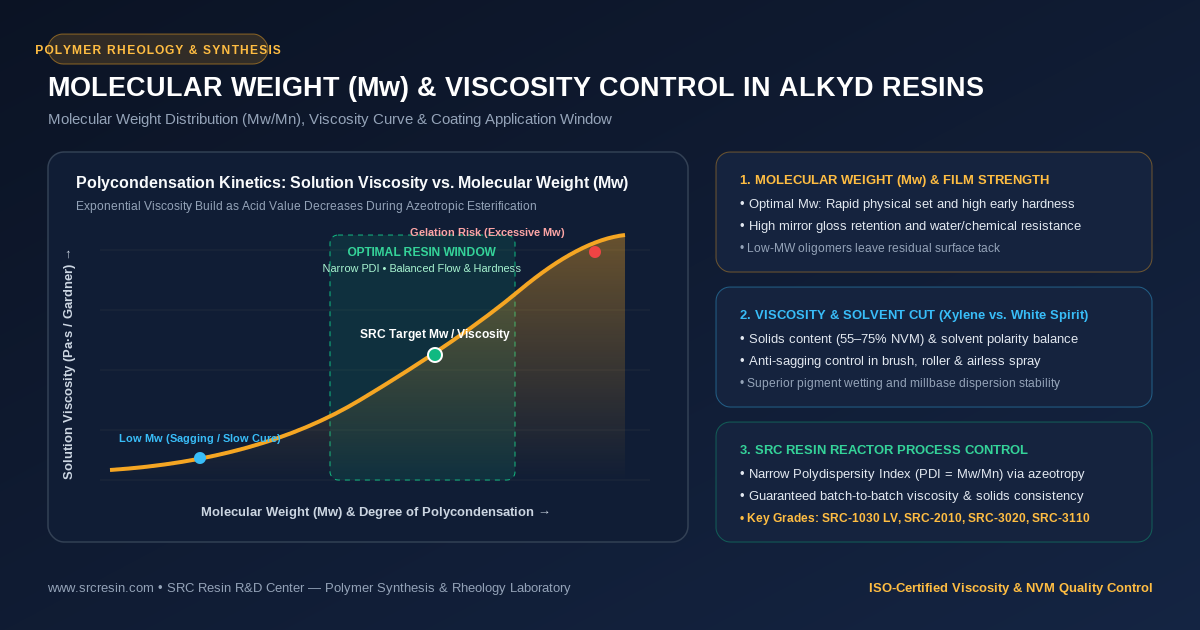
Molecular Weight (Mw) & Viscosity Impact on Coating Performance
How polymer chain length and viscosity control affect paint formulation and application.
| Parameter | Too Low Mw / Low Viscosity | Optimal Mw & Narrow PDI (SRC Standard) | Excessive Mw / High Viscosity |
|---|---|---|---|
| Application Solids & VOC | High solids at gun, lower VOC | Balanced solids (58–75% NVM) & rheology | Requires excessive thinner, higher VOC |
| Leveling & Sag Resistance | Good flow but prone to vertical sagging | Smooth brush/spray leveling with sag control | Orange peel texture & poor substrate wetting |
| Drying Speed & Hardness | Slow tack-free time, soft early film | Rapid physical + oxidative cure, high gloss | Surface skinning & wrinkling risk |
| In-Can Storage Stability | Stable viscosity, pigment settling risk | Long shelf life & batch-to-batch consistency | Viscosity drift & gelation risk in storage |
Recommended SRC Alkyd Resin Products for This Application
Explore our industrial alkyd resin grades manufactured at our 1,500 tons/month Izmir plant, engineered to meet the technical parameters discussed in this guide:
ALKYD S62 W70 LV (Low Viscosity)
Controlled low-viscosity long oil alkyd enabling high application solids and superior leveling.
ALKYD FA50 X70 (Medium Oil)
Narrow-PDI medium oil alkyd offering excellent spray atomization, gloss, and mechanical strength.
ALKYD FA43 X65 (Short Oil)
High-build short oil alkyd engineered for 2K polyurethane and cellulosic wood coatings.
Frequently Asked Engineering Questions
Why is a narrow polydispersity index (PDI = Mw/Mn) critical in alkyd resins?
A broad PDI contains low-molecular-weight oligomers that act as permanent plasticizers causing surface tack, alongside ultra-high-MW microgel fractions that cause haze and poor leveling. A narrow PDI ensures predictable viscosity, crisp gloss, and fast through-cure.
Why do two alkyd resins with the same solid content (NVM %) have different viscosities?
Solution viscosity depends on average molecular weight (Mw), degree of branching (pentaerythritol vs. glycerol functionality), and solvent hydrogen-bonding power (aromatic Xylene yields lower viscosity than aliphatic White Spirit at equal solids).
Which SRC Resin grades are engineered for high-solids, low-viscosity formulations?
SRC-1030 (ALKYD S62 W70 LV, 1.5–3.5 Pa·s) and SRC-1050 (73–77% NVM) are specifically synthesized for high-build, low-VOC architectural and industrial coatings with effortless leveling.