Rapid Curing Solutions for Industrial Coatings
Fast drying alkyd resins are specifically designed to reduce drying time, increase production efficiency and improve surface performance in industrial coating applications. Unlike conventional alkyd systems, these resins provide controlled yet rapid oxidative curing, making them ideal for modern, high-speed production environments.
In many industrial processes, drying time is a critical bottleneck. Fast drying alkyd systems help overcome this limitation by delivering quicker film formation without sacrificing hardness, gloss or durability.
Where Are Fast Drying Alkyd Resins Used?
Fast drying alkyd resins are commonly used in applications where short drying time and stable film performance are essential:
Industrial primers and topcoats
Hammertone and decorative effect coatings
Road marking paints
2K and catalyzed coating systems
Accelerated or oven-assisted curing applications
These systems are preferred when fast turnaround times and consistent surface quality are required.
Advantages of Fast Drying Alkyd Systems
Compared to standard alkyd resins, fast drying alkyd systems offer several key advantages:
Significantly reduced drying time
Improved solvent release
High and long-lasting gloss
Enhanced resistance to yellowing
Balanced hardness and flexibility
These benefits directly contribute to higher productivity and more reliable coating performance.
How Does SRC-3110 (ALKYD FA27 X60) Fit into This Category?
SRC-3110 (ALKYD FA27 X60) is a vegetable fatty acid-based, short oil, fast drying alkyd resin developed for demanding industrial applications.
With its optimized structure, it delivers rapid curing while maintaining excellent film properties.
Key performance characteristics include
Very fast drying behavior
High gloss and gloss retention
Excellent yellowing resistance
Balanced film hardness and flexibility
Compatibility with aromatic and aliphatic isocyanates
SRC-3110 is well suited for fast drying industrial coatings where production speed and surface quality are equally important.
Who Should Use This Type of Alkyd Resin?
Fast drying alkyd resins such as SRC-3110 are particularly suitable for
Industrial paint manufacturers
Producers of hammertone and decorative coatings
Road marking paint formulators
Manufacturers working with 2K coating systems
Production lines where drying time is critical
When reduced curing time and stable performance are key requirements, fast drying alkyd systems provide a reliable solution.
Conclusion
Fast drying alkyd resins represent a technical response to the increasing demand for speed and performance in industrial coatings.
SRC-3110 (ALKYD FA27 X60) is designed to meet these requirements by combining rapid drying with durable and high-quality film formation.
When applied in the right systems, it helps shorten production cycles and ensures consistent coating performance.
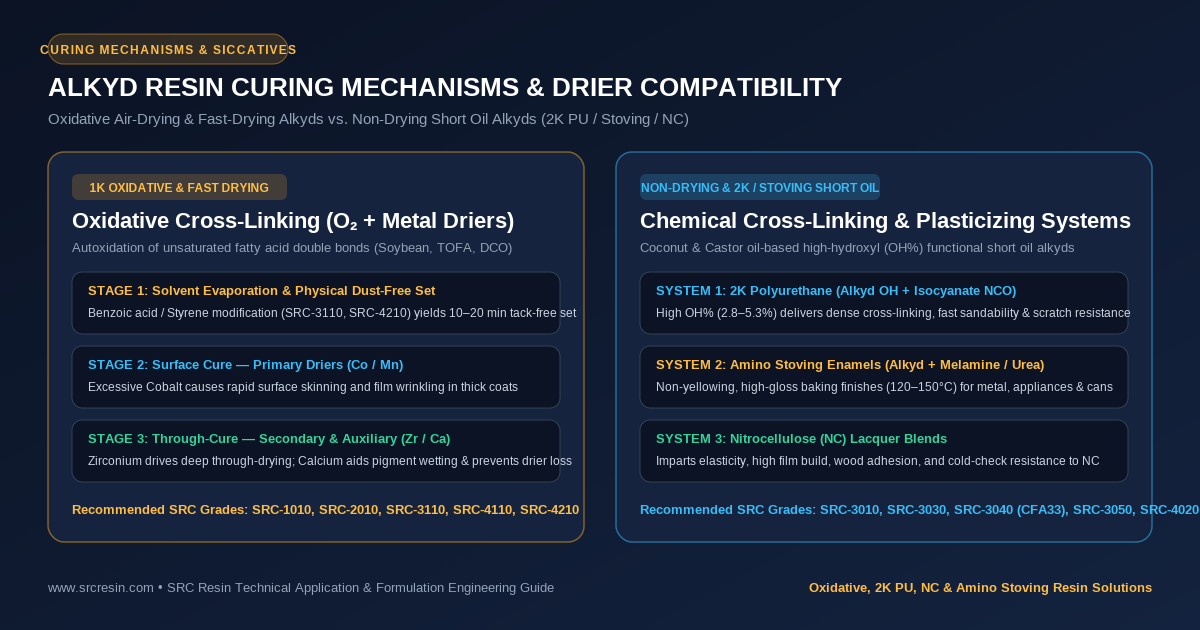
Fast-Drying vs. Non-Drying Short Oil vs. Standard Oxidative Alkyd Comparison Table
Technical comparison of curing mechanisms, drier/crosslinker requirements, and drying times.
| Feature | Fast-Drying Alkyd Resin | Non-Drying Short Oil Alkyd | Standard Oxidative Long/Medium Oil Alkyd |
|---|---|---|---|
| Oil Length & Chemistry | 27–38% Oil (Benzoic Acid / Styrene Modified) | 28–38% Oil (Saturated Coconut / Castor FA) | 47–68% Oil (Soybean / TOFA / Vegetable FA) |
| Curing Mechanism | Rapid Solvent Release + O₂ Crosslinking | Chemical Crosslinking (2K NCO / Amino) or NC | Autoxidative Crosslinking (Co / Zr / Ca Driers) |
| Dust-Free Drying (20°C) | 10 – 20 Minutes | 5–10 min (in NC) / 15–25 min (in 2K PU) | 45 – 120 Minutes |
| Drier / Hardener System | Balanced Co / Zr / Ca + Anti-skinning agent | No metal driers (Cured with Polyisocyanate/Melamine) | Standard Co (0.04–0.06%) + Zr (0.15–0.3%) + Ca (0.1–0.2%) |
| Representative SRC Grades | SRC-3110, SRC-3112, SRC-3120, SRC-4210 | SRC-3040, SRC-3030, SRC-4010, SRC-4020 | SRC-1010, SRC-1040, SRC-2010 |
Recommended SRC Alkyd Resin Products for This Application
Explore our industrial alkyd resin grades manufactured at our 1,500 tons/month Izmir plant, engineered to meet the technical parameters discussed in this guide:
ALKYD FA27 X60 (Fast Drying Alkyd)
Flagship fast-drying alkyd for rapid-cure industrial primers, topcoats, hammertone paints, and road marking.
ALKYD CFA33 BG60 (Non-Drying Short Oil)
High-OH non-yellowing short oil alkyd for 2K polyurethane coatings, amino stoving enamels, and can coatings.
ALKYD FA25 X60 ST (Styrenated Alkyd)
Ultra-fast drying styrenated alkyd for structural steel primers and high-speed industrial production lines.
Frequently Asked Engineering Questions
What causes surface wrinkling and soft through-cure in alkyd paints?
Excessive primary surface drier (Cobalt) or overly thick film application causes rapid skinning of the top layer, blocking oxygen diffusion into the lower film. Balancing Cobalt with through-driers (Zirconium) and auxiliary wetting driers (Calcium) ensures uniform top-to-bottom curing.
What is the difference between a Fast-Drying Alkyd and a Non-Drying Short Oil Alkyd?
Fast-Drying Alkyds (e.g., SRC-3110) are formulated with unsaturated fatty acids and benzoic acid modification to air-dry rapidly in 1K industrial coatings. Non-Drying Short Oil Alkyds (e.g., SRC-3040) use saturated fatty acids (Coconut/Castor) that do not oxidize in air; instead, their high OH% crosslinks with polyisocyanates (2K PU) or melamine resins (stoving), or plasticizes nitrocellulose (NC).
How can loss of dry during paint storage be prevented?
High-surface-area pigments (such as carbon black and TiO₂) can adsorb Cobalt driers over time. Incorporating Calcium auxiliary drier during pigment grinding (millbase) and using SRC Resin’s controlled-acid-value alkyds prevents drier adsorption and maintains consistent drying speed.