
Urethane & Polyurethane Modified Alkyd Resins — Marine, Parquet & 2K Furniture Binders
Engineered with urethane (-NH-CO-O-) linkages in the polymer backbone for superior abrasion, impact, water, and chemical resistance—spanning 1K air-drying Uralkyds and high-OH 2K PU-modified alkyds.
ALKYD CFA31 X60 PU
Short Oil Alkyd Resin Based on Coconut Fatty Acid
ALKYD CFA30 X70 PU
Short Oil Alkyd Resin Based on Coconut Fatty Acid
ALKYD FA38 X60 PU
Vegetable Fatty Acid Based Short Oil Alkyd Resin Modified with Aromatic Isocyanates
ALKYD S25 X45 PU
Soybean Oil Based Short Oil Alkyd Resin Modified with Aromatic Isocyanates
ALKYD FA54 W60 UR
Air Drying Urethane Modified Medium-Oil Alkyd Resin Based on Vegetable Fatty Acid
ALKYD FA60 W60 UR
Air Drying Aliphatic Isocyanate Modified Long-Oil Alkyd Resin Based on Vegetable Fatty Acid
ALKYD FA60 D60 UR
Air Drying Aliphatic Isocyanate Modified Long-Oil Alkyd Resin Based on Vegetable Fatty Acid
ALKYD S62 W55 UR
Air Drying Urethane Modified Long-Oil Alkyd Resin Based on Soybean Oil
ALKYD S62 D58 UR
Air Drying Aromatic Isocyanate Modified Long-Oil Alkyd Resin Based on Soybean Oil
Chemical Architecture of Urethane (Uralkyd) & Polyurethane Modified Alkyd Resins
Urethane and polyurethane modified alkyd resins are synthesized by reacting diisocyanate monomers (aromatic TDI or non-yellowing aliphatic diisocyanates) with polyol/fatty acid intermediates during polycondensation. Incorporating urethane (-NH-CO-O-) linkages into the polyester backbone creates strong inter-chain hydrogen bonding—dramatically accelerating tack-free drying while boosting surface hardness, Taber abrasion resistance, water/alkali barrier properties, and impact toughness.
SRC Resin manufactures two distinct engineering sub-series within this portfolio: 1) The SRC-4100 Series (Urethane Modified / 1K Uralkyds — SRC-4110 to SRC-4130): 52–62% oil length resins supplied in White Spirit or D40 that cure oxidatively with metal driers for 1K yacht and parquet floor varnishes (including non-yellowing aliphatic grades SRC-4120/4121). 2) The SRC-4000 Series (Polyurethane Modified / 2K PU — SRC-4010 to SRC-4031): 25–31% oil length resins in Xylene featuring high hydroxyl functionality (3.00% – 5.30% OH) for rapid-sanding 2K furniture sealers and non-yellowing Coconut topcoats.
4 Engineering Advantages of the Urethane & PU Series
Covers both White Spirit-soluble 1K marine/parquet varnishes (SRC-4100) and Xylene-cut 2K wood coatings (SRC-4000).
Prevents UV yellowing in clear exterior marine yacht varnishes and architectural white enamels.
SRC-4030 (5.30% OH) enables 45–60 min powder-sanding in high-build 2K polyurethane furniture sealers.
Superior resistance to foot traffic, salt water, household detergents, and thermal shock.
Primary Varnish, Flooring & Wood Coating Applications
How coating formulators deploy SRC-4000 (2K PU) and SRC-4100 (1K Uralkyd) grades:
Marine Yacht & Boat Spar Varnishes (1K)
High-gloss clear marine varnishes engineered to withstand saltwater spray, intense UV sunlight, and timber movement.
Hardwood Parquet, Flooring & Stair Varnishes (1K)
Single-component floor coatings delivering high scratch, heel-mark, abrasion, and household chemical resistance.
2K Polyurethane Furniture Sealers & White Topcoats
Ultra-fast sanding 2K wood sealers and Coconut-based non-yellowing high-gloss white/clear furniture lacquers.
Heavy-Duty Maintenance & Floor Enamels
Fast-drying industrial metal maintenance paints and concrete floor coatings requiring chemical and wear durability.
Curing Systems for 1K Urethane Alkyds vs. 2K PU-Modified Alkyds
Select the appropriate curing system based on whether you are formulating with the 1K SRC-4100 series or the 2K SRC-4000 series:
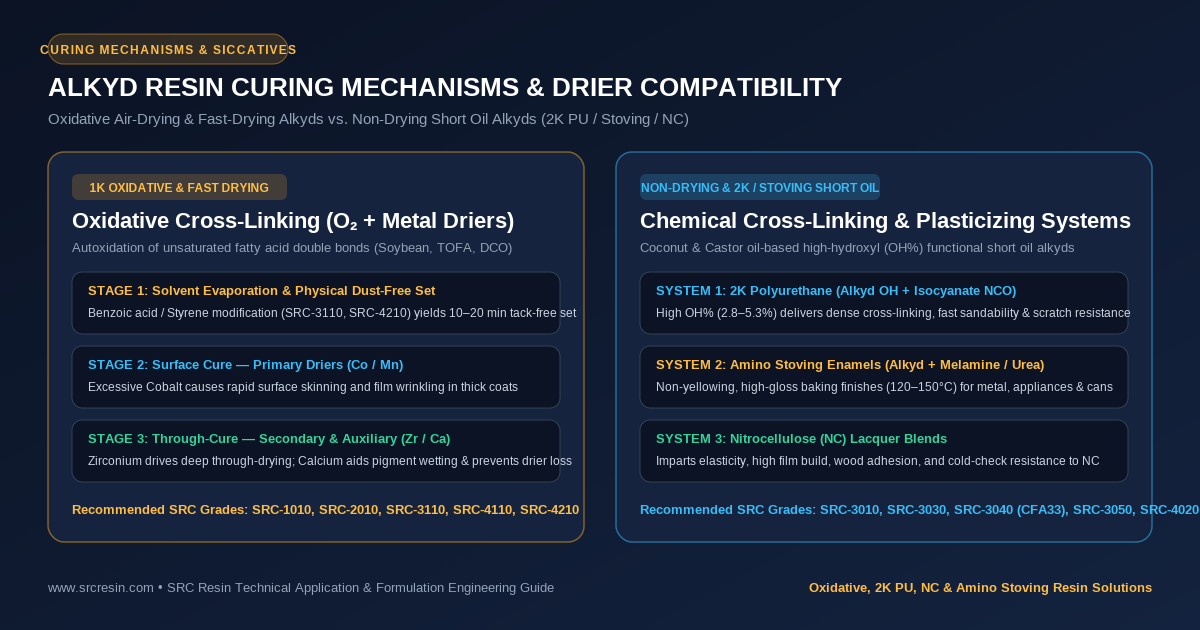
Soluble in White Spirit / D40; cures by air oxidation with 0.25% MEKO anti-skinning agent.
Coconut fatty acid backbone ensures non-yellowing whiteness in 2K furniture finishes.
High OH density delivers rapid cross-linking and effortless dry sanding without gumming.
R&D Technical Articles on Alkyd Resin Chemistry
Explore in-depth formulation guides authored by our polymer engineering team.
Why Is Molecular Weight Critical in Alkyd Resins?
Molecular weight in alkyd resins directly affects viscosity, application behavior and coating performance. Achieving the right balance between low and high molecular weight is critical for consistent product quality and optimal film properties.
Why Do Alkyd Resins Yellow?
Yellowing in alkyd resins is influenced by fatty acid structure, curing mechanism, drier balance and environmental exposure. In light-colored coatings, color stability is a critical performance factor. This article explains the technical causes of yellowing in alkyd systems and outlines how proper resin selection and curing design can minimize discoloration.
Why Do Alkyd Paints Fail to Dry? Drier and Resin Compatibility
Delayed drying and surface tackiness problems observed in alkyd paints are often caused not by the amount of drier used, but by incompatibility between the drier and the alkyd resin. Incorrect drier selection can lead to performance loss even when the correct resin is used. This article explains why drier compatibility is critical in alkyd resin systems and how drier selection should be made for long oil, medium oil and short oil alkyd systems from a manufacturer’s perspective. Русская версия
URETHANE & PU ALKYD TECHNICAL FAQ
Frequently Asked Questions About Urethane & PU Modified Alkyds
TDI-modified aromatic urethane alkyd (SRC-4110) offers maximum drying speed, surface hardness, and abrasion resistance for interior parquet varnishes and pigmented coatings. Aliphatic isocyanate-modified urethane alkyds (SRC-4120 and SRC-4121) contain no aromatic urethane rings, preventing UV photo-oxidation yellowing in clear marine yacht varnishes and white enamels.
The SRC-4000 series combines internal polyurethane chain modification with elevated hydroxyl values (3.00% to 5.30% OH). When cured with polyisocyanates, they achieve faster tack-free times, superior powder-sanding in sealers (SRC-4030), and deeper mirror gloss with Coconut-based non-yellowing stability (SRC-4010, SRC-4020).
Because urethane hydrogen bonding accelerates surface set, formulators should add 0.20–0.35% MEKO (Methyl Ethyl Ketoxime) on resin solids and keep Cobalt metal dosage at 0.04–0.05% balanced with Zirconium and Calcium.
Let's Select the Optimal Alkyd or Acrylic Resin for Your Formulation
Our R&D engineering team provides laboratory samples, TDS/SDS documentation, and custom viscosity or solids adjustments.
Request Quote & Sample