
Fast Drying Alkyd Resins (27–38% Oil Length) — Chain-Stopped Rapid-Cure Industrial Binders
Benzoic acid chain-stopped short oil alkyd resins delivering 10–20 minute dust-free drying, early part handling, high gloss, and safe intercoat recoatability for high-throughput industrial metal coatings.
ALKYD FA27 X60
Fast Drying Short Oil Alkyd Resin Based on Vegetable Fatty Acid
ALKYD S27 X60
Fast Drying Short Oil Alkyd Resin Based on Soybean Oil
ALKYD FA27 X70
Fast Drying Short Oil Alkyd Resin Based on Vegetable Fatty Acid
ALKYD FA27 T70
Fast Drying Short Oil Alkyd Resin Based on Vegetable Fatty Acid
ALKYD S27 X70
Fast Drying Short Oil Alkyd Resin Based on Soybean Oil
ALKYD S38 X60
Fast Drying Short Oil Alkyd Resin Based on Soybean Oil
ALKYD FA31 X60
Fast Drying Short Oil Alkyd Resin Based on Vegetable Fatty Acid
Fast Drying Alkyd Chemistry: Benzoic Acid Chain-Stopping & Two-Stage Curing Kinetics
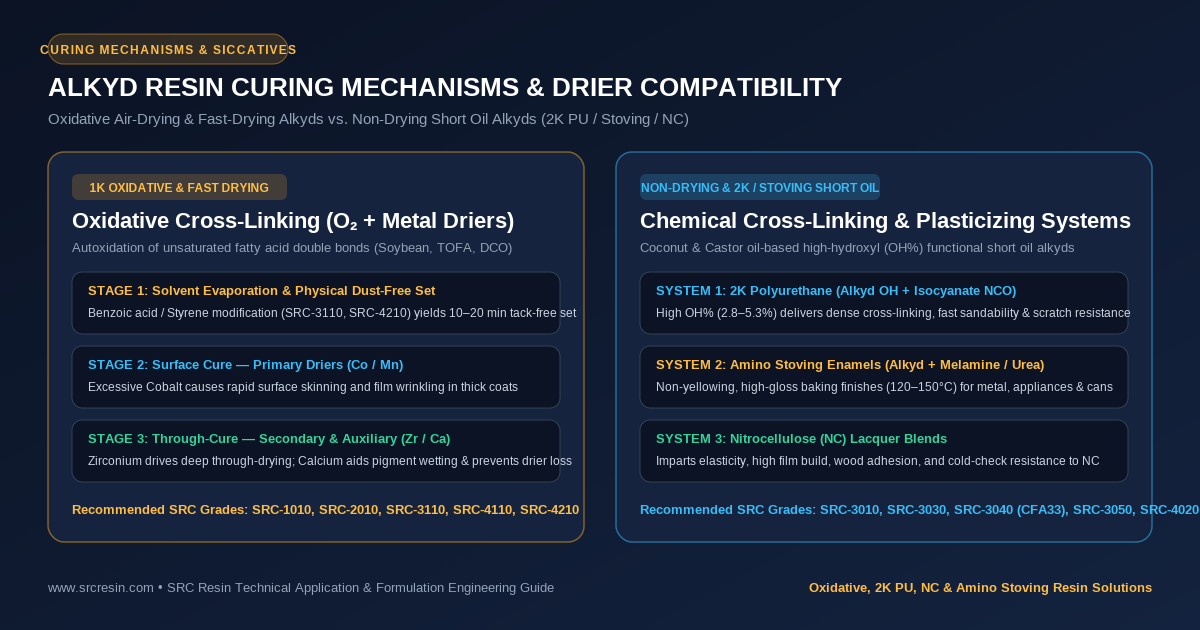
Fast drying alkyd resins (Chain-Stopped Short Oil Alkyds, 27–38% oil length) are synthesized by modifying an unsaturated fatty acid / phthalic anhydride backbone with aromatic monobasic acids (benzoic acid or p-tert-butylbenzoic acid). Acting as a chain terminator, benzoic acid restricts excessive branching while sharply elevating the polymer’s glass transition temperature (Tg)—enabling lacquer-like physical tack-free drying within 10 to 20 minutes as Xylene or Toluene evaporates.
Unlike styrenated alkyds that can suffer from solvent-lifting during recoating, SRC Resin’s SRC-3100 series (SRC-3110 to SRC-3130) retains active polyunsaturated fatty acid double bonds. Following rapid physical set, stage-two oxidative cross-linking develops deep through-hardness, exterior durability, and reliable intercoat adhesion.
Core Engineering Specifications of the Fast Drying Series
Accelerates shop-floor throughput, allowing rapid handling, assembly, and stacking of coated metal parts.
High polymer Tg for rapid solvent release paired with oxidative cross-linking for recoat safety.
Includes high-solids 70% NVM Xylene cut (SRC-3112) and ultra-fast flashing Toluene cut (SRC-3111).
Strong polar adhesion to steel and cast iron, with crisp mirror-like finish in OEM enamels.
Primary Rapid-Cure Industrial Applications
Where OEM and industrial paint formulators deploy the SRC-3100 fast drying series:
Rapid-Cure Structural Steel Primers & 1K Topcoats
High-speed shop primers and Direct-to-Metal (DTM) finishes for steel fabrication, containers, valves, and castings.
Hammertone & Industrial Texture Effect Finishes
High initial viscosity and rapid film setting lock in crisp hammertone pattern formation without sagging.
Single-Component Road Marking & Traffic Paints
Fast-setting alkyd traffic coatings (standalone or chlorinated rubber blends) for quick no-pick-up times.
OEM Machinery, Drum & Forced-Drying Enamels
Versatile industrial finishes suitable for ambient 1K curing, 80°C forced drying, or amino-modified baking.
Drier Dosage & Recoat Window Guidelines for Fast Drying Alkyds
Because chain-stopped alkyds reach physical set rapidly via solvent evaporation, moderate drier dosages prevent brittleness and ensure optimal intercoat adhesion:
Metal on solid resin; avoids surface skinning while driving rapid oxidative cross-linking.
Benzoic acid modification minimizes solvent lifting compared to high-styrene resins.
Prevents dry-spray overspray dusting in warm shop conditions and maximizes gloss.
R&D Technical Articles on Alkyd Resin Chemistry
Explore in-depth formulation guides authored by our polymer engineering team.
Differences Between Fast Drying Alkyd Resins and Non-Drying Alkyd Resins
Fast drying and non-drying alkyd resins are designed for different curing mechanisms in industrial coating systems. While fast drying alkyds cure by air oxidation, non-drying alkyds require controlled curing such as oven or catalytic systems. This article explains the key differences between fast drying and non-drying alkyd resins and provides guidance on selecting the correct system for industrial applications.
What Is a Fast Drying Alkyd Resin?
Fast drying alkyd resins are developed to minimize drying time while maintaining high film performance in industrial coating applications. Short oil alkyd systems offer rapid curing, high gloss and balanced mechanical properties. This article explains where fast drying alkyd resins are used, their advantages, and how SRC-3110 (ALKYD FA27 X60) fits into this category as a reliable solution for high-speed industrial coatings.
Drying Problems in Alkyd Resin Production
A Manufacturer’s Approach to Drying Problems in Alkyd Resins Delayed drying, surface tackiness and performance issues in alkyd paints are mostly caused not by application, but by the structure of the alkyd resin itself. When fatty acid selection, acid value, molecular weight and drier compatibility are not properly designed, the system cannot perform as expected. In this article, we explain the real reasons behind drying problems in alkyd resin production and how these issues can be solved at the manufacturing stage, from a true producer’s perspective.
FAST DRYING ALKYD TECHNICAL FAQ
Frequently Asked Questions About Fast Drying Alkyd Resins
Although both have short oil lengths (27–40%), Fast Drying Alkyds (SRC-3110 to SRC-3130) are synthesized from unsaturated drying fatty acids with benzoic acid chain-stopping so they air-dry rapidly in 1K systems. Non-Drying Short Oil Alkyds (SRC-3040, SRC-3050) use saturated fatty acids and require a 2K isocyanate hardener, melamine stoving resin, or NC to form a hard film.
Choose 27% oil length grades (SRC-3110, SRC-3111, SRC-3112) when maximum drying speed and early handling hardness are the top priority (e.g., steel shop primers, castings, drums). Choose 35–38% soybean oil grades (SRC-3120, SRC-3130) when you need rapid drying combined with higher film flexibility and outdoor UV gloss retention.
SRC-3112 (ALKYD FA27 X70) is supplied at 70% non-volatile matter (NVM) in Xylene, allowing higher film build per pass with reduced solvent emissions.
Let's Select the Optimal Alkyd or Acrylic Resin for Your Formulation
Our R&D engineering team provides laboratory samples, TDS/SDS documentation, and custom viscosity or solids adjustments.
Request Quote & Sample