
Long Oil Alkyd Resins (55–70% Oil Length) — Architectural & Decorative Coating Binders
Soybean oil and distilled fatty acid-based long oil alkyd resins engineered for full aliphatic solvent (White Spirit, D40) solubility, effortless brush/roller leveling, high gloss retention, and exterior weatherability.
ALKYD FA60 W70
Long-Oil Oxidative Drying Alkyd Resin Based on Soybean Oil Fatty Acid
ALKYD S60 W70
Long-Oil Oxidative Drying Alkyd Resin Based on Soybean Oil
ALKYD S62 W70 LV
Long-Oil Oxidative Drying Alkyd Resin Based on Soybean Oil
ALKYD S64 W70
Long-Oil Oxidative Drying Alkyd Resin Based on Soybean Oil
ALKYD S64 D70
Long-Oil Oxidative Drying Alkyd Resin Based on Soybean Oil
ALKYD S68 W75
Long-Oil Oxidative Drying Alkyd Resin Based on Soybean Oil
ALKYD FA55 W70
Long-Oil Oxidative Drying Alkyd Resin Based on Vegetable Fatty Acid
ALKYD FA55 W70
Long-Oil Oxidative Drying Alkyd Resin Based on Vegetable Fatty Acid
Long Oil Alkyd Resin Chemistry, Formulation Guidelines & Coating Performance
Long oil alkyd resins contain 55% to 70% by weight of unsaturated vegetable oils (soybean oil, sunflower oil) or distilled fatty acids esterified with high-functionality polyols (pentaerythritol) and phthalic anhydride. Their high fatty acid content imparts low polymer polarity, enabling complete dilution in mild, low-odor aliphatic hydrocarbons (White Spirit, Dearomatized D40/D60) and providing extended wet-edge open time.
Synthesized under strict azeotropic polycondensation control at SRC Resin’s Izmir plant, our SRC-1000 series combines narrow polydispersity (Mw/Mn) with high non-volatile matter (60–75% NVM). Grades such as SRC-1010, SRC-1020, and SRC-1050 deliver rapid oxidative cross-linking, outstanding gloss retention, non-yellowing whiteness stability, and long-term dimensional elasticity on exterior wood and metal substrates.
Core Engineering Specifications of the Long Oil Series
Provides superior outdoor UV weathering durability, substrate flexibility, and yellowing resistance.
Full aliphatic hydrocarbon solubility; supports high-solids, low-VOC architectural formulations (SRC-1050 at 75% NVM).
Available in low-viscosity high-solids cuts (SRC-1030 LV) and high-build grades (SRC-1010/1060) for brush-mark-free leveling.
Ensures rapid TiO2 pigment wetting, gloss development, and in-can stability with basic extenders.
Primary Paint & Coating Applications
Where formulators deploy SRC-1000 series long oil alkyd resins:
Architectural High-Gloss & Satin Enamels
Interior and exterior decorative trim paints, doors, windows, and metalwork finishes requiring mirror-like gloss and color retention.
Wood Stains, Clear Varnishes & Marine Topcoats
Highly flexible clear and pigmented wood coatings and above-waterline marine enamels that resist cracking and moisture ingress.
High-Solids / Low-VOC Decorative Coatings
Low-viscosity resin cuts allowing higher solids at application viscosity with reduced solvent emissions.
Synthetic Undercoats & Anticorrosive Primers
Deep-penetrating wood and metal primers offering easy sandability, pigment loading capacity, and strong intercoat adhesion.
Recommended Siccative (Drier) Combination for Long Oil Alkyds
Long oil alkyds cure via atmospheric oxygen uptake and hydroperoxide free-radical cross-linking. To prevent surface wrinkling in thick films and achieve uniform through-drying, metal drier dosages (calculated as % metal on solid resin) should be balanced as follows:
Catalyzes hydroperoxide decomposition for rapid surface tack-free drying.
Promotes uniform cross-linking throughout the film depth and improves hardness and gloss.
Prevents drier adsorption onto pigments, improves wetting, and eliminates in-can skinning.
R&D Technical Articles on Alkyd Resin Chemistry
Explore in-depth formulation guides authored by our polymer engineering team.
Why Do Alkyd Resins Yellow?
Yellowing in alkyd resins is influenced by fatty acid structure, curing mechanism, drier balance and environmental exposure. In light-colored coatings, color stability is a critical performance factor. This article explains the technical causes of yellowing in alkyd systems and outlines how proper resin selection and curing design can minimize discoloration.
Why Do Alkyd Paints Fail to Dry? Drier and Resin Compatibility
Delayed drying and surface tackiness problems observed in alkyd paints are often caused not by the amount of drier used, but by incompatibility between the drier and the alkyd resin. Incorrect drier selection can lead to performance loss even when the correct resin is used. This article explains why drier compatibility is critical in alkyd resin systems and how drier selection should be made for long oil, medium oil and short oil alkyd systems from a manufacturer’s perspective. Русская версия
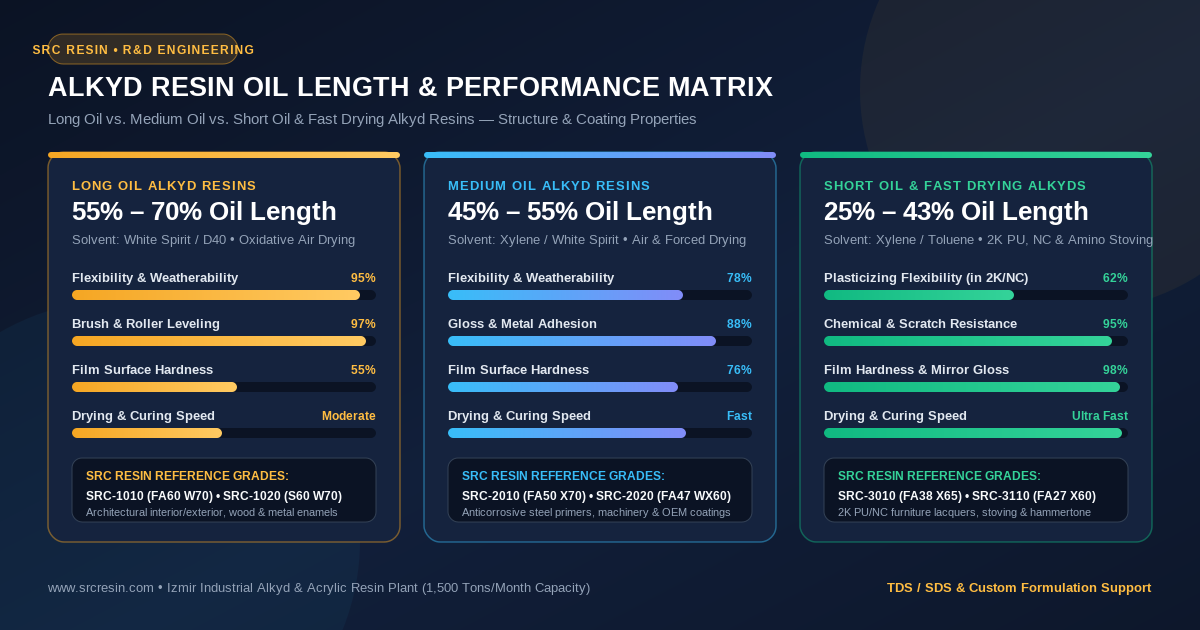
Differences Between Long Oil, Medium Oil and Short Oil Alkyd Resins
Long oil, medium oil and short oil alkyd resins differ in terms of drying time, flexibility, hardness and application areas. Selecting the correct alkyd resin directly affects coating performance and helps prevent drying and application issues. This content explains the key differences between alkyd resin types from a manufacturer’s perspective and provides technical guidance for selecting the right resin for decorative and industrial applications.
LONG OIL ALKYD TECHNICAL FAQ
Frequently Asked Questions About Long Oil Alkyd Resins
Fatty acid-synthesized SRC-1010 allows direct esterification with pentaerythritol, resulting in a narrower molecular weight distribution and faster initial set-to-touch time. Soybean oil-based SRC-1020 is produced via alcoholysis-esterification, delivering superior brushability, wet-edge retention, and long-term non-yellowing whiteness in architectural enamels.
Surface wrinkling occurs when excessive Cobalt drier causes rapid surface skinning that blocks oxygen diffusion into the lower film layers. Keeping Cobalt at 0.04–0.05%, increasing Zirconium through-drier (0.20–0.25%) with Calcium (0.15%), and using controlled-viscosity grades like SRC-1030 LV ensures smooth, wrinkle-free curing.
SRC-1031 (ALKYD S63 D70) is supplied directly in Dearomatized D40 at 70% solids, while SRC-1050 (75% NVM) provides ultra-high solids for low-odor interior and exterior decorative coatings.
Let's Select the Optimal Alkyd or Acrylic Resin for Your Formulation
Our R&D engineering team provides laboratory samples, TDS/SDS documentation, and custom viscosity or solids adjustments.
Request Quote & Sample