
Medium Oil Alkyd Resins (45–55% Oil Length) — Industrial Metal & Anticorrosive Binders
Engineered to bridge rapid drying with long-term outdoor durability for structural steel primers, agricultural & earthmoving machinery enamels, chassis coatings, and general industrial finishes.
ALKYD FA50 X70
Medium-Oil Air Drying Alkyd Resin Based on Vegetable Fatty Acid
ALKYD FA50 W60
Medium-Oil Air Drying Alkyd Resin Based on Vegetable Fatty Acid
ALKYD FA50 WX55
Medium-Oil Air Drying Alkyd Resin Based on Vegetable Fatty Acid
ALKYD TFA50 WX60
Medium-Oil Air Drying Alkyd Resin Based on Tall Oil Fatty Acid
ALKYD TFA50 X65
Tall Oil Yağ Asidi Bazlı, Orta Yağlı, Hava İle Kuruyan Alkid Reçinesi
ALKYD FA47 WX60
Medium-Oil Air Drying Alkyd Resin Based on Vegetable Fatty Acid
ALKYD FA47 SS50
Medium-Oil Air Drying Alkyd Resin Based on Vegetable Fatty Acid
Medium Oil Alkyd Chemistry, Corrosion Protection & Industrial Formulation
Medium oil alkyd resins (45–55% oil length) occupy the sweet spot of industrial coating chemistry—combining the outdoor elasticity and weatherability of long oil alkyds with the rapid tack-free drying, higher glass transition temperature (Tg), and surface hardness of short oil grades. The elevated phthalate ester density reduces moisture permeability and strengthens adhesion to ferrous substrates.
Supplied in Xylene or White Spirit/Xylene blends across 55% to 70% solids (NVM), SRC Resin’s SRC-2000 series (SRC-2010, SRC-2013, SRC-2020, SRC-2030) is synthesized from distilled vegetable fatty acids, soybean oil, and tall oil fatty acid (TOFA). These grades exhibit superior wetting of zinc phosphate and iron oxide anticorrosive pigments, high spray gloss, and reliable recoatability.
Core Engineering Specifications of the Medium Oil Series
Balances fast solvent release and oxidative cure with mechanical impact resistance.
Optimized for conventional and airless spray atomization, sag control, and rapid flash-off.
Strong polar adhesion to steel substrates and high compatibility with anticorrosive inhibitive pigments.
Available from high-solids 70% NVM cuts (SRC-2010) to high-viscosity thixotropic-friendly cuts (SRC-2040).
Primary Industrial Coating Applications
How industrial paint manufacturers utilize the SRC-2000 medium oil alkyd portfolio:
Anticorrosive Structural Steel Primers
Zinc phosphate and red iron oxide metal primers offering strong moisture barrier and salt-spray durability.
Agricultural, Tractor & Earthmoving Machinery Enamels
High-gloss industrial topcoats resistant to outdoor UV exposure, diesel/hydraulic fluid splashes, and stone chipping.
Automotive Chassis, Wheel & Commercial Vehicle Finishes
Air-drying and forced-drying (60–80°C) enamels for truck frames, trailers, and commercial vehicle refinishing.
General Industrial Maintenance & Traffic Coatings
High-dilution-capacity medium oil grades for cost-effective metal maintenance enamels and road marking blends.
Air Drying & Forced Drying Recommendations for Medium Oil Alkyds
Medium oil alkyds cure efficiently at ambient temperatures (20–25°C) with metal driers or in forced-drying ovens (60–80°C) on OEM assembly lines:
Calculated as metal on solid resin; yields 20–30 min dust-free drying and rapid handling hardness.
After 10 min ambient flash-off, accelerates through-cure for immediate part assembly and stacking.
Enhances spray leveling, eliminates orange peel, and prevents blushing in humid conditions.
R&D Technical Articles on Alkyd Resin Chemistry
Explore in-depth formulation guides authored by our polymer engineering team.
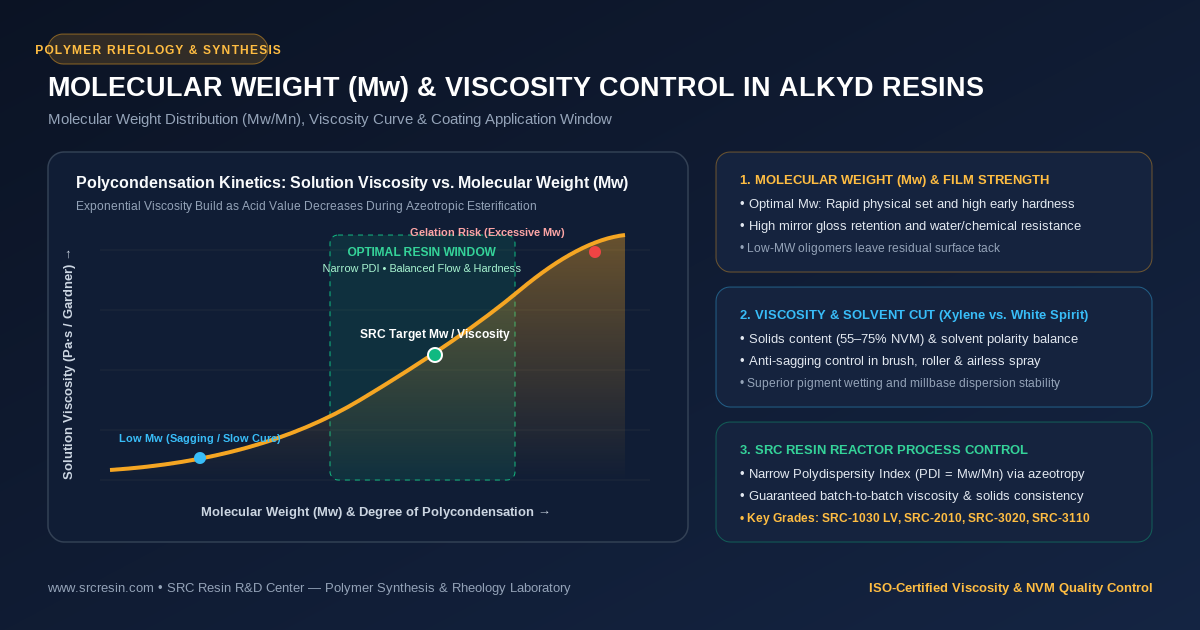
Why Is Molecular Weight Critical in Alkyd Resins?
Molecular weight in alkyd resins directly affects viscosity, application behavior and coating performance. Achieving the right balance between low and high molecular weight is critical for consistent product quality and optimal film properties.
What Does Viscosity Affect in Alkyd Resins?
Its Role in Production Quality and Coating Performance In alkyd resin production, viscosity is often treated as a simple quality control parameter. However, in reality, viscosity is a critical factor that directly influences both the manufacturing process and the final coating performance. An alkyd resin with an incorrect viscosity range can lead to application issues, surface defects and inconsistent film properties. What Is Viscosity in Alkyd Resins? Viscosity is the resistance of a liquid to flow. In alkyd resins, viscosity is influenced by: Molecular weight Solid content Solvent type Resin structure Each of these parameters plays a role in defining how the resin behaves during application. Key Factors That Determine Viscosity 1. Molecular Weight As molecular weight increases, viscosity increases. This typically results in: Higher film strength More difficult application Balancing molecular weight is essential for optimal performance. 2. Solid Content Higher solid content leads to higher viscosity. This means: Lower solvent levels More concentrated resin structure High-solid systems are often preferred for performance, but require careful viscosity control. 3. Solvent System The type of solvent used significantly affects viscosity. The same resin may behave differently depending on the solvent system, influencing flow, leveling and application properties. How Does Viscosity Affect Application? Viscosity is not just a lab value. It directly impacts real-world application: Ease of application Flow and leveling Brush and roller marks Film thickness control Surface smoothness Incorrect viscosity often results in poor surface quality. Viscosity and Film Performance Viscosity also affects the final film properties: Too low viscosity → weak film, low durability Too high viscosity → poor leveling, surface defects The goal is to achieve the correct balance between application and performance. Conclusion from a Manufacturer’s Perspective In alkyd resins, viscosity is not just a measurement—it is a defining characteristic of the product. Proper viscosity control: Improves process efficiency Enhances application behavior Ensures consistent coating performance For this reason, viscosity should be considered as critical as formulation design.
Differences Between Long Oil, Medium Oil and Short Oil Alkyd Resins
Long oil, medium oil and short oil alkyd resins differ in terms of drying time, flexibility, hardness and application areas. Selecting the correct alkyd resin directly affects coating performance and helps prevent drying and application issues. This content explains the key differences between alkyd resin types from a manufacturer’s perspective and provides technical guidance for selecting the right resin for decorative and industrial applications.
MEDIUM OIL ALKYD TECHNICAL FAQ
Frequently Asked Questions About Medium Oil Alkyd Resins
With a 47–52% oil length, medium oil alkyds contain a higher proportion of aromatic phthalate segments, raising the polymer Tg. This provides faster solvent release, shorter tack-free times, harder films, and lower water vapor transmission for superior corrosion protection on steel.
Choose 100% Xylene-cut SRC-2010 (70% NVM) for fast-drying industrial spray enamels, OEM machinery topcoats, and high-solids primers. Choose White Spirit/Xylene blends (SRC-2013, SRC-2020, SRC-2030) when brush/roller application, longer open time, or higher thinner dilution capacity is required.
Tall Oil Fatty Acid (TOFA) with controlled rosin modification in SRC-2013 promotes rapid early hardness development, superior wetting of iron oxide and zinc phosphate pigments, and strong adhesion to blasted or phosphated steel.
Let's Select the Optimal Alkyd or Acrylic Resin for Your Formulation
Our R&D engineering team provides laboratory samples, TDS/SDS documentation, and custom viscosity or solids adjustments.
Request Quote & Sample