
Styrenated Alkyd Resins (25–40% Oil Length) — Ultra-Fast Drying Industrial & Hammertone Binders
Synthesized via free-radical graft copolymerization of styrene monomer onto unsaturated alkyd backbones—delivering 5–15 minute dust-free drying, high early hardness, metal adhesion, and moisture barrier protection.
ALKYD FA25 X60 ST
Styrenated Short Oil Alkyd Resin Based on Vegetable Fatty Acid
ALKYD DCO31 X60 STAC
Styrene & Acrylic Modified Short Oil Alkyd Resin Based on Dehydrated Castor Oil Fatty Acid
ALKYD TFA30 X60 ST
Styrenated Short Oil Alkyd Resin Based on Tall Oil Fatty Acid
ALKYD S40 X60 ST
Styrenated Short Oil Alkyd Resin Based on Soybean Oil
Styrenated Alkyd Chemistry, Rapid Solvent Release & Metal Barrier Performance
Styrene modified (styrenated) alkyd resins are produced by free-radical graft copolymerization of styrene monomer onto short-to-medium oil alkyd backbones containing conjugated or unsaturated fatty acids—such as Dehydrated Castor Oil (DCO), Tall Oil Fatty Acid (TOFA), or distilled vegetable fatty acids. Grafting rigid aromatic polystyrene segments onto the polyester chain dramatically increases the glass transition temperature (Tg).
Supplied at 60% solids (NVM) in Xylene, SRC Resin’s SRC-4200 series (SRC-4210, SRC-4220, SRC-4230, SRC-4240) achieves lacquer-like dust-free drying within 5 to 15 minutes upon solvent flash-off. The hydrophobic styrene rings provide low water vapor permeability, strong alkali resistance, and rapid pattern fixation in structural steel primers, hammertone effect coatings, and high-speed OEM metal finishes.
Core Engineering Specifications of the Styrenated Series
Rigid styrene segments deliver immediate tack-free handling as soon as Xylene evaporates.
Includes conjugated DCO-based SRC-4220 for superior adhesion/flexibility and TOFA-based SRC-4230 for high hardness.
High-viscosity SRC-4240 (9–13 Pa·s) locks in crisp hammertone crater patterns without vertical sagging.
Excellent water, humidity, and salt-fog barrier on blasted steel and cast iron substrates.
Primary High-Speed Industrial Applications
Where paint manufacturers specify SRC-4200 series styrenated alkyd resins:
High-Throughput Structural Steel & Shop Primers
Fast-handling anticorrosive primers for steel beams, pipes, and fabricated parts that can be moved and stacked within minutes.
Hammertone & Metallic Effect Coatings
Rapid viscosity build and film set freeze aluminum leafing and silicone hammertone patterns with sharp definition.
OEM Castings, Valves, Motors & Drum Enamels
Rapid-drying industrial topcoats for electric motors, pumps, machinery housings, and steel drums.
Rapid-Cure Industrial Lacquer & Baking Blends
Co-binders for fast-drying industrial lacquers and low-bake metal finishes requiring high initial gloss.
Drier Dosage & Recoat Window Management for Styrenated Alkyds
Styrenated alkyds dry primarily by rapid solvent evaporation followed by secondary oxidative cross-linking of residual fatty acid double bonds. To prevent intercoat lifting:
Minimal metal drier loading accelerates secondary oxidative cross-linking without embrittling the film.
Applying the topcoat wet-on-wet avoids aromatic solvent lifting during the intermediate curing stage.
Conjugated DCO and higher oil content increase oxidative cross-link density and solvent resistance.
R&D Technical Articles on Alkyd Resin Chemistry
Explore in-depth formulation guides authored by our polymer engineering team.
What Does Viscosity Affect in Alkyd Resins?
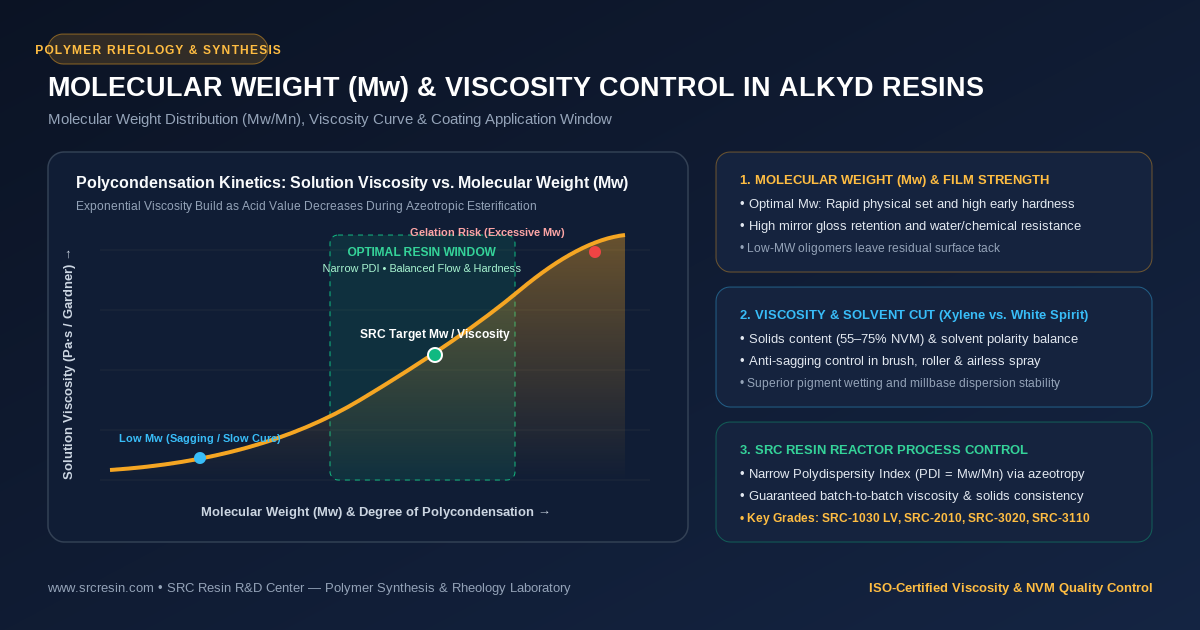
Its Role in Production Quality and Coating Performance In alkyd resin production, viscosity is often treated as a simple quality control parameter. However, in reality, viscosity is a critical factor that directly influences both the manufacturing process and the final coating performance. An alkyd resin with an incorrect viscosity range can lead to application issues, surface defects and inconsistent film properties. What Is Viscosity in Alkyd Resins? Viscosity is the resistance of a liquid to flow. In alkyd resins, viscosity is influenced by: Molecular weight Solid content Solvent type Resin structure Each of these parameters plays a role in defining how the resin behaves during application. Key Factors That Determine Viscosity 1. Molecular Weight As molecular weight increases, viscosity increases. This typically results in: Higher film strength More difficult application Balancing molecular weight is essential for optimal performance. 2. Solid Content Higher solid content leads to higher viscosity. This means: Lower solvent levels More concentrated resin structure High-solid systems are often preferred for performance, but require careful viscosity control. 3. Solvent System The type of solvent used significantly affects viscosity. The same resin may behave differently depending on the solvent system, influencing flow, leveling and application properties. How Does Viscosity Affect Application? Viscosity is not just a lab value. It directly impacts real-world application: Ease of application Flow and leveling Brush and roller marks Film thickness control Surface smoothness Incorrect viscosity often results in poor surface quality. Viscosity and Film Performance Viscosity also affects the final film properties: Too low viscosity → weak film, low durability Too high viscosity → poor leveling, surface defects The goal is to achieve the correct balance between application and performance. Conclusion from a Manufacturer’s Perspective In alkyd resins, viscosity is not just a measurement—it is a defining characteristic of the product. Proper viscosity control: Improves process efficiency Enhances application behavior Ensures consistent coating performance For this reason, viscosity should be considered as critical as formulation design.
What Is a Fast Drying Alkyd Resin?
Fast drying alkyd resins are developed to minimize drying time while maintaining high film performance in industrial coating applications. Short oil alkyd systems offer rapid curing, high gloss and balanced mechanical properties. This article explains where fast drying alkyd resins are used, their advantages, and how SRC-3110 (ALKYD FA27 X60) fits into this category as a reliable solution for high-speed industrial coatings.
Drying Problems in Alkyd Resin Production
A Manufacturer’s Approach to Drying Problems in Alkyd Resins Delayed drying, surface tackiness and performance issues in alkyd paints are mostly caused not by application, but by the structure of the alkyd resin itself. When fatty acid selection, acid value, molecular weight and drier compatibility are not properly designed, the system cannot perform as expected. In this article, we explain the real reasons behind drying problems in alkyd resin production and how these issues can be solved at the manufacturing stage, from a true producer’s perspective.
STYRENATED ALKYD TECHNICAL FAQ
Frequently Asked Questions About Styrene Modified Alkyd Resins
DCO contains a high percentage of conjugated linoleic double bonds, allowing uniform chemical grafting of styrene onto the fatty acid chains without forming incompatible homopolystyrene. This gives SRC-4220 crystal-clear film clarity, superior adhesion to steel, higher flexibility, and improved recoatability.
Hammertone finishes require high initial viscosity and instant surface setting to freeze the crater pattern formed by silicone additives and leafing aluminum. SRC-4240 (40% oil, 9–13 Pa·s viscosity in Xylene) prevents vertical sagging while locking in a uniform, sharp hammertone texture.
Because styrenated alkyds have fewer oxidative double bonds than standard alkyds, applying a Xylene-rich topcoat during the intermediate curing window (between 3 and 18 hours) can swell the primer. Formulators avoid lifting by recoating wet-on-wet within 1–2 hours, adding a balanced Co/Zr drier package, or selecting higher-oil/DCO grades like SRC-4220 and SRC-4240.
Let's Select the Optimal Alkyd or Acrylic Resin for Your Formulation
Our R&D engineering team provides laboratory samples, TDS/SDS documentation, and custom viscosity or solids adjustments.
Request Quote & Sample