
Its Impact on Viscosity, Application and Film Performance
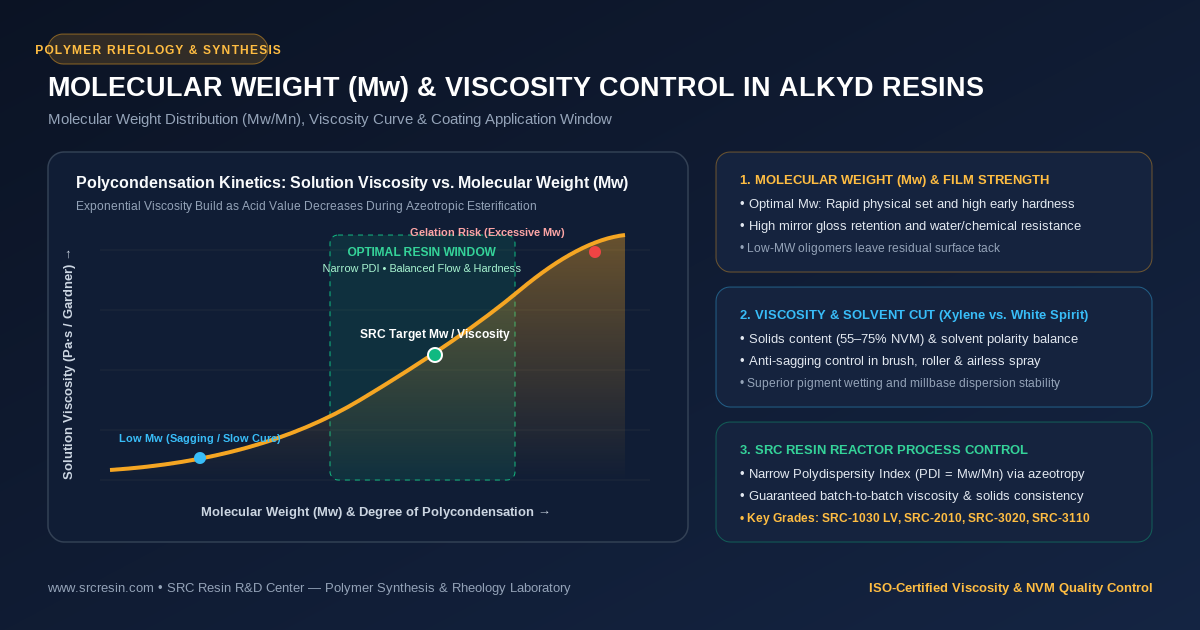
In alkyd resin production, molecular weight is often considered an indirect parameter. However, in reality, it is one of the most critical factors that determine viscosity, application behavior and final coating performance.
An alkyd resin with an uncontrolled molecular weight distribution can lead to application issues, inconsistent viscosity and weak film properties.
What Is Molecular Weight in Alkyd Resins?
Molecular weight refers to the size and length of polymer chains that form the resin structure. In alkyd systems, it is influenced by:
Reaction time
Raw material selection
Oil length
Acid value
These parameters define how the resin behaves during both production and application.
How Molecular Weight Affects Viscosity
As molecular weight increases
Polymer chains become longer
Flow resistance increases
Viscosity rises
This means viscosity is essentially a result of molecular structure.
Impact on Film Performance
Molecular weight directly influences coating properties
Low molecular weight
Lower film strength
Reduced durability
Better flow but weaker performance
High molecular weight
Stronger and more resistant film
Better chemical resistance
More difficult application
The key is achieving the right balance.
Effect on Application
Molecular weight also determines how the coating behaves during application
Flow and leveling
Surface smoothness
Brush and roller marks
Film uniformity
Incorrect molecular weight leads to poor surface quality.
Importance in Production
Process control directly affects molecular weight.
Uncontrolled production may result in
Fluctuating viscosity
Inconsistent product quality
Unstable performance
Consistency in molecular weight means consistency in product performance.
Conclusion
Molecular weight in alkyd resins is not just a technical parameter—it defines the character of the product.
Proper control of molecular weight
Balances viscosity
Improves application
Optimizes film performance
A high-quality alkyd resin always starts with controlled molecular structure.
Molecular Weight (Mw) & Viscosity Impact on Coating Performance
How polymer chain length and viscosity control affect paint formulation and application.
| Parameter | Too Low Mw / Low Viscosity | Optimal Mw & Narrow PDI (SRC Standard) | Excessive Mw / High Viscosity |
|---|---|---|---|
| Application Solids & VOC | High solids at gun, lower VOC | Balanced solids (58–75% NVM) & rheology | Requires excessive thinner, higher VOC |
| Leveling & Sag Resistance | Good flow but prone to vertical sagging | Smooth brush/spray leveling with sag control | Orange peel texture & poor substrate wetting |
| Drying Speed & Hardness | Slow tack-free time, soft early film | Rapid physical + oxidative cure, high gloss | Surface skinning & wrinkling risk |
| In-Can Storage Stability | Stable viscosity, pigment settling risk | Long shelf life & batch-to-batch consistency | Viscosity drift & gelation risk in storage |
Recommended SRC Alkyd Resin Products for This Application
Explore our industrial alkyd resin grades manufactured at our 1,500 tons/month Izmir plant, engineered to meet the technical parameters discussed in this guide:
ALKYD S62 W70 LV (Low Viscosity)
Controlled low-viscosity long oil alkyd enabling high application solids and superior leveling.
ALKYD FA50 X70 (Medium Oil)
Narrow-PDI medium oil alkyd offering excellent spray atomization, gloss, and mechanical strength.
ALKYD FA43 X65 (Short Oil)
High-build short oil alkyd engineered for 2K polyurethane and cellulosic wood coatings.
Frequently Asked Engineering Questions
Why is a narrow polydispersity index (PDI = Mw/Mn) critical in alkyd resins?
A broad PDI contains low-molecular-weight oligomers that act as permanent plasticizers causing surface tack, alongside ultra-high-MW microgel fractions that cause haze and poor leveling. A narrow PDI ensures predictable viscosity, crisp gloss, and fast through-cure.
Why do two alkyd resins with the same solid content (NVM %) have different viscosities?
Solution viscosity depends on average molecular weight (Mw), degree of branching (pentaerythritol vs. glycerol functionality), and solvent hydrogen-bonding power (aromatic Xylene yields lower viscosity than aliphatic White Spirit at equal solids).
Which SRC Resin grades are engineered for high-solids, low-viscosity formulations?
SRC-1030 (ALKYD S62 W70 LV, 1.5–3.5 Pa·s) and SRC-1050 (73–77% NVM) are specifically synthesized for high-build, low-VOC architectural and industrial coatings with effortless leveling.