Drier Compatibility in Alkyd Resins
The Hidden Cause of Drying Problems
A large proportion of delayed drying, surface tackiness and performance losses observed in alkyd paints are caused not by drier dosage, but by incompatibility between the drier and the alkyd resin.
In many systems, the problem is attempted to be solved by increasing the drier amount. However, this approach often makes the problem worse.
In this article, we discuss why drier compatibility is critical in alkyd resin systems and how the correct system should be established from a manufacturer’s perspective.
What Is the Function of Driers in Alkyd Resins?
Driers are metal-based additives that accelerate the oxidative drying reaction in alkyd resins.
Their main function is to enable the resin to react with air and to complete film formation.
However, not every drier works in the same way with every alkyd resin.
Most Commonly Used Drier Types
The most commonly used driers in alkyd systems are
Cobalt-based driers
Zirconium-based driers
Calcium-based driers
Each of these driers plays a different role and they work as a system rather than individually.
Why Does Drier Incompatibility Occur?
Drier incompatibility generally arises from the following reasons
- Selection of a drier that is not suitable for the oil length of the alkyd resin
- Use of alkyd resins with a high acid value
- Uncontrolled molecular weight structure of the resin
- Attempting to solve the entire system with a single type of drier
In such cases, increasing the drier amount does not eliminate drying problems.
Drier Compatibility in Long Oil Alkyd Resins
Long oil alkyd resins naturally dry more slowly.
In these systems, drier selection is particularly critical.
Points to consider
Excessive cobalt usage may cause surface drying
Drying in lower layers may be delayed
Surface tackiness may occur
For this reason, a balanced drier combination should be preferred in long oil alkyd systems.
Drier Compatibility in Medium Oil Alkyd Resins
Medium oil alkyd resins are the most tolerant systems in terms of drier compatibility.
However, incorrect adjustment can still result in performance loss.
Possible problems
Irregular drying
Insufficient film hardness
Surface marking over time
In these systems, drier ratios should be adjusted according to the application area.
Drier Compatibility in Short Oil Alkyd Resins
Short oil alkyd resins are mostly used in modified systems.
Therefore, the curing mechanism is as important as drier selection.
Incorrect drier usage may lead to
Brittle film structure
Excessive hardening
Reduced application tolerance
In these systems, driers alone are not a complete solution.
Clear Advice from the Manufacturer
In most systems experiencing drying problems, the issue lies not in
The drier brand
The drier dosage
But in the compatibility between the alkyd resin and the drier.
The correct combination of alkyd resin and drier balances the system from the beginning and eliminates problems encountered in real applications.
Conclusion
Driers are an essential component of alkyd systems. However, when not selected correctly, they lock the system instead of improving performance.
Therefore, drier selection must be evaluated together with the alkyd resin structure and the intended application.
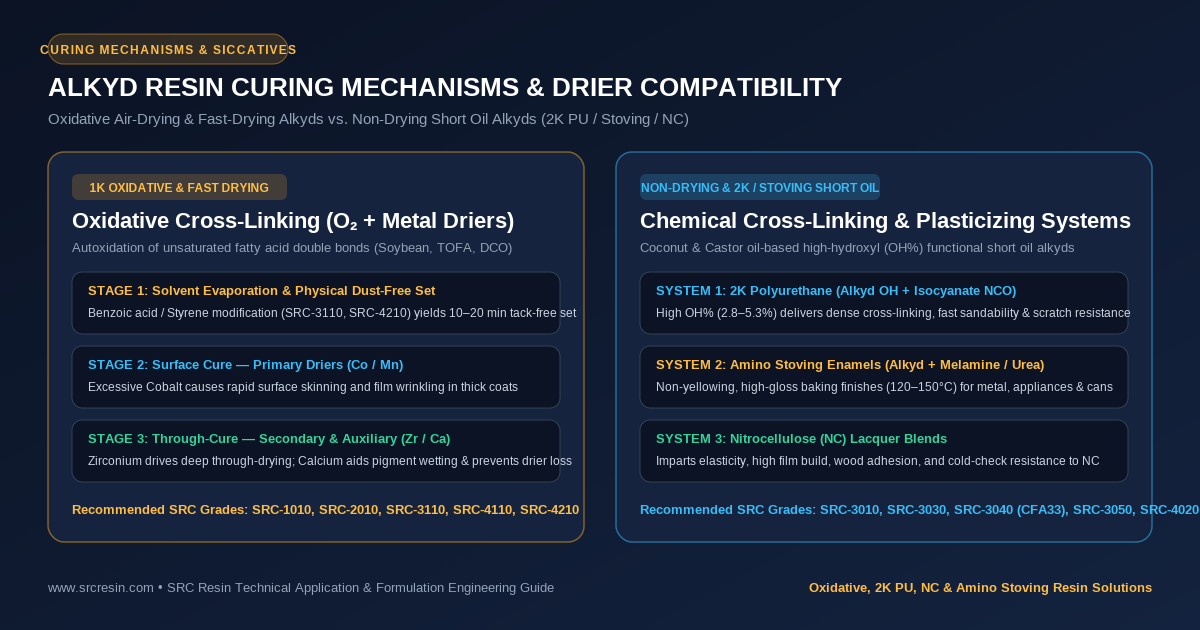
Fast-Drying vs. Non-Drying Short Oil vs. Standard Oxidative Alkyd Comparison Table
Technical comparison of curing mechanisms, drier/crosslinker requirements, and drying times.
| Feature | Fast-Drying Alkyd Resin | Non-Drying Short Oil Alkyd | Standard Oxidative Long/Medium Oil Alkyd |
|---|---|---|---|
| Oil Length & Chemistry | 27–38% Oil (Benzoic Acid / Styrene Modified) | 28–38% Oil (Saturated Coconut / Castor FA) | 47–68% Oil (Soybean / TOFA / Vegetable FA) |
| Curing Mechanism | Rapid Solvent Release + O₂ Crosslinking | Chemical Crosslinking (2K NCO / Amino) or NC | Autoxidative Crosslinking (Co / Zr / Ca Driers) |
| Dust-Free Drying (20°C) | 10 – 20 Minutes | 5–10 min (in NC) / 15–25 min (in 2K PU) | 45 – 120 Minutes |
| Drier / Hardener System | Balanced Co / Zr / Ca + Anti-skinning agent | No metal driers (Cured with Polyisocyanate/Melamine) | Standard Co (0.04–0.06%) + Zr (0.15–0.3%) + Ca (0.1–0.2%) |
| Representative SRC Grades | SRC-3110, SRC-3112, SRC-3120, SRC-4210 | SRC-3040, SRC-3030, SRC-4010, SRC-4020 | SRC-1010, SRC-1040, SRC-2010 |
Recommended SRC Alkyd Resin Products for This Application
Explore our industrial alkyd resin grades manufactured at our 1,500 tons/month Izmir plant, engineered to meet the technical parameters discussed in this guide:
ALKYD FA27 X60 (Fast Drying Alkyd)
Flagship fast-drying alkyd for rapid-cure industrial primers, topcoats, hammertone paints, and road marking.
ALKYD CFA33 BG60 (Non-Drying Short Oil)
High-OH non-yellowing short oil alkyd for 2K polyurethane coatings, amino stoving enamels, and can coatings.
ALKYD FA25 X60 ST (Styrenated Alkyd)
Ultra-fast drying styrenated alkyd for structural steel primers and high-speed industrial production lines.
Frequently Asked Engineering Questions
What causes surface wrinkling and soft through-cure in alkyd paints?
Excessive primary surface drier (Cobalt) or overly thick film application causes rapid skinning of the top layer, blocking oxygen diffusion into the lower film. Balancing Cobalt with through-driers (Zirconium) and auxiliary wetting driers (Calcium) ensures uniform top-to-bottom curing.
What is the difference between a Fast-Drying Alkyd and a Non-Drying Short Oil Alkyd?
Fast-Drying Alkyds (e.g., SRC-3110) are formulated with unsaturated fatty acids and benzoic acid modification to air-dry rapidly in 1K industrial coatings. Non-Drying Short Oil Alkyds (e.g., SRC-3040) use saturated fatty acids (Coconut/Castor) that do not oxidize in air; instead, their high OH% crosslinks with polyisocyanates (2K PU) or melamine resins (stoving), or plasticizes nitrocellulose (NC).
How can loss of dry during paint storage be prevented?
High-surface-area pigments (such as carbon black and TiO₂) can adsorb Cobalt driers over time. Incorporating Calcium auxiliary drier during pigment grinding (millbase) and using SRC Resin’s controlled-acid-value alkyds prevents drier adsorption and maintains consistent drying speed.