Causes and Practical Solutions
Alkyd resins have long been a reliable backbone of the paint industry. However, when they are not properly designed or when production parameters are not well controlled, drying problems become inevitable in real applications.
Complaints such as “slow drying,” “sticky surface,” or “marking the next day” are often attributed to application errors. In reality, the root cause of these issues is usually the chemical structure of the alkyd resin and the production process itself.
In this article, we clearly explain the main reasons behind drying problems in alkyd resins and how they can be resolved — from the perspective of an alkyd resin manufacturer.
Why Do Alkyd Paints Dry Slowly?
In alkyd systems, drying is not only about solvent evaporation. The real curing mechanism is oxidative crosslinking.
This process depends on the proper interaction between
Resin structure
Type of fatty acids
Molecular weight
Drier system compatibility
If this balance is not achieved, proper curing will not occur — regardless of drying time.
Main Causes of Drying Problems
1️⃣ Incorrect Fatty Acid Selection
Long oil alkyd resins provide flexibility but naturally dry more slowly. The type of fatty acid used (soybean oil, sunflower oil, tall oil, etc.) directly affects drying speed.
Choosing an unsuitable fatty acid for the application results in extended drying times and surface defects.
2️⃣ High Acid Value
A high acid value in the resin
Reduces drier efficiency
Slows down oxidative curing
Causes permanent surface tackiness
Failing to terminate the reaction at the correct point is one of the most common production mistakes.
3️⃣ Uncontrolled Molecular Weight
Excessively low molecular weight leads to weak film formation, while excessively high molecular weight slows down oxidation.
An ideal alkyd resin must have a balanced molecular structure, tailored to its specific application.
4️⃣ Drier–Resin Incompatibility
A very common misconception is
“If we increase the drier dosage, the problem will disappear.”
The real issue is not quantity, but compatibility. Cobalt, zirconium and calcium-based driers must be properly matched to the alkyd resin structure. Otherwise, increasing dosage will not improve performance.
5️⃣ Application Conditions
Thick film application, low ambient temperature and insufficient air circulation can negatively affect drying. However, a well-designed alkyd resin should perform reliably under normal application conditions.
Common Mistakes in Alkyd Resin Production
Ending the reaction too early
Discharging the resin before achieving a proper acid value
Trying to use a single alkyd resin for all applications
Attempting to solve drying issues only by adjusting driers
These practices may save time in the short term but lead to performance issues and customer dissatisfaction in the long run.
Choosing the Right Alkyd for the Right Application
Wood coatings & varnishes: Long oil alkyds
Metal coatings & general industrial paints: Medium oil alkyds
Industrial systems requiring fast drying: Short oil or modified alkyds
The approach of “one alkyd fits all” no longer meets modern performance expectations.
Conclusion: Drying Problems Start — and End — with the Resin
Most drying issues observed in the field originate from improper alkyd resin selection or incorrect production parameters. A properly designed alkyd resin significantly improves paint performance and ensures smoother application.
We approach alkyd resin production not as a standard product supply, but as a solution-oriented process.
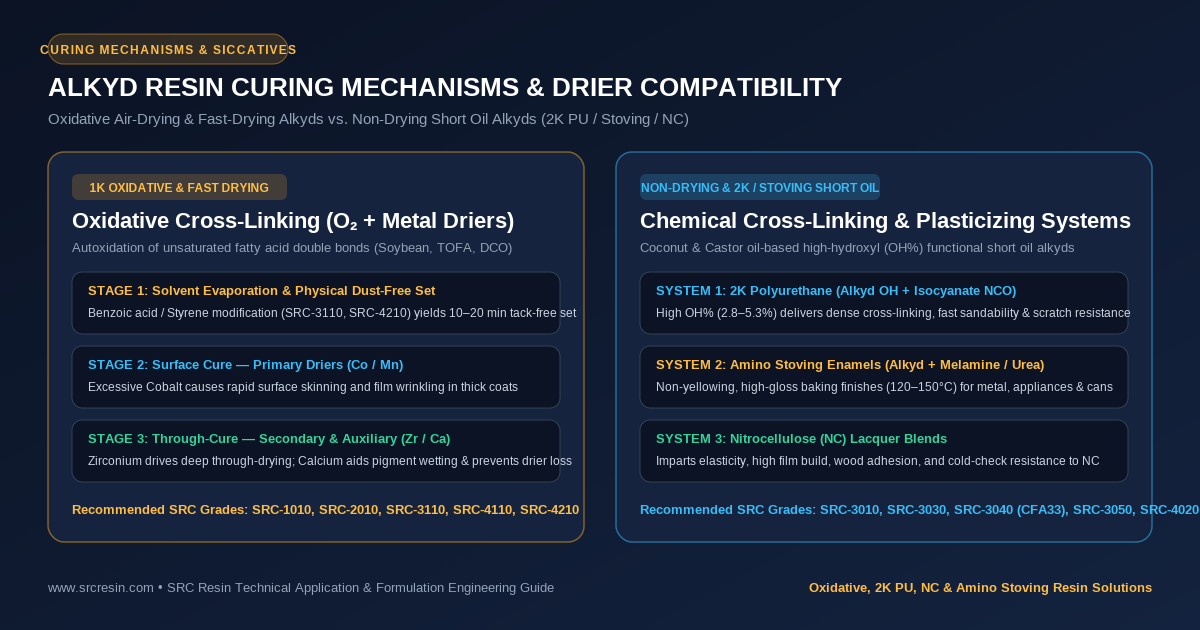
Fast-Drying vs. Non-Drying Short Oil vs. Standard Oxidative Alkyd Comparison Table
Technical comparison of curing mechanisms, drier/crosslinker requirements, and drying times.
| Feature | Fast-Drying Alkyd Resin | Non-Drying Short Oil Alkyd | Standard Oxidative Long/Medium Oil Alkyd |
|---|---|---|---|
| Oil Length & Chemistry | 27–38% Oil (Benzoic Acid / Styrene Modified) | 28–38% Oil (Saturated Coconut / Castor FA) | 47–68% Oil (Soybean / TOFA / Vegetable FA) |
| Curing Mechanism | Rapid Solvent Release + O₂ Crosslinking | Chemical Crosslinking (2K NCO / Amino) or NC | Autoxidative Crosslinking (Co / Zr / Ca Driers) |
| Dust-Free Drying (20°C) | 10 – 20 Minutes | 5–10 min (in NC) / 15–25 min (in 2K PU) | 45 – 120 Minutes |
| Drier / Hardener System | Balanced Co / Zr / Ca + Anti-skinning agent | No metal driers (Cured with Polyisocyanate/Melamine) | Standard Co (0.04–0.06%) + Zr (0.15–0.3%) + Ca (0.1–0.2%) |
| Representative SRC Grades | SRC-3110, SRC-3112, SRC-3120, SRC-4210 | SRC-3040, SRC-3030, SRC-4010, SRC-4020 | SRC-1010, SRC-1040, SRC-2010 |
Recommended SRC Alkyd Resin Products for This Application
Explore our industrial alkyd resin grades manufactured at our 1,500 tons/month Izmir plant, engineered to meet the technical parameters discussed in this guide:
ALKYD FA27 X60 (Fast Drying Alkyd)
Flagship fast-drying alkyd for rapid-cure industrial primers, topcoats, hammertone paints, and road marking.
ALKYD CFA33 BG60 (Non-Drying Short Oil)
High-OH non-yellowing short oil alkyd for 2K polyurethane coatings, amino stoving enamels, and can coatings.
ALKYD FA25 X60 ST (Styrenated Alkyd)
Ultra-fast drying styrenated alkyd for structural steel primers and high-speed industrial production lines.
Frequently Asked Engineering Questions
What causes surface wrinkling and soft through-cure in alkyd paints?
Excessive primary surface drier (Cobalt) or overly thick film application causes rapid skinning of the top layer, blocking oxygen diffusion into the lower film. Balancing Cobalt with through-driers (Zirconium) and auxiliary wetting driers (Calcium) ensures uniform top-to-bottom curing.
What is the difference between a Fast-Drying Alkyd and a Non-Drying Short Oil Alkyd?
Fast-Drying Alkyds (e.g., SRC-3110) are formulated with unsaturated fatty acids and benzoic acid modification to air-dry rapidly in 1K industrial coatings. Non-Drying Short Oil Alkyds (e.g., SRC-3040) use saturated fatty acids (Coconut/Castor) that do not oxidize in air; instead, their high OH% crosslinks with polyisocyanates (2K PU) or melamine resins (stoving), or plasticizes nitrocellulose (NC).
How can loss of dry during paint storage be prevented?
High-surface-area pigments (such as carbon black and TiO₂) can adsorb Cobalt driers over time. Incorporating Calcium auxiliary drier during pigment grinding (millbase) and using SRC Resin’s controlled-acid-value alkyds prevents drier adsorption and maintains consistent drying speed.