Key Differences Between Long Oil, Medium Oil and Short Oil Alkyd Resins
Long oil, medium oil and short oil alkyd resins differ in terms of drying time, flexibility, hardness and application areas. These differences directly affect paint performance and final application results.
Properties of Long Oil Alkyd Resins
Long oil alkyd resins contain a high proportion of fatty acids. This structure provides better flexibility and easier application.
Main characteristics
- Long drying time
- High flexibility
- Low film hardness
- Air-drying through oxidative curing
Typical applications
- Decorative paints
- Wood coatings
- General purpose synthetic paints
Properties of Medium Oil Alkyd Resins
Medium oil alkyd resins offer a balanced structure between long oil and short oil systems. They provide controlled performance in terms of application ease and mechanical strength.
Main characteristics
- Medium drying speed
- Balanced flexibility and hardness
- Higher film strength compared to long oil alkyds
Typical applications
- Industrial metal coatings
- Machinery and equipment paints
- General industrial coatings
Properties of Short Oil Alkyd Resins
Short oil alkyd resins contain a lower amount of fatty acids. As a result, they form harder and more durable films but are usually used in modified systems.
Main characteristics
- Short drying time, but modification is required
- Low flexibility
- High film hardness
- High chemical and mechanical resistance
Typical applications
- Baking enamels
- High performance industrial coatings
- Modified alkyd-based systems
Summary Evaluation
Long oil alkyd resins are suitable for decorative applications.
Medium oil alkyd resins are preferred for industrial and general-purpose uses.
Short oil alkyd resins are used in heavy-duty industrial applications where high durability is required.
Selecting the correct alkyd resin prevents drying problems and application defects from the beginning. Therefore, oil length selection should be based on application requirements rather than product price.
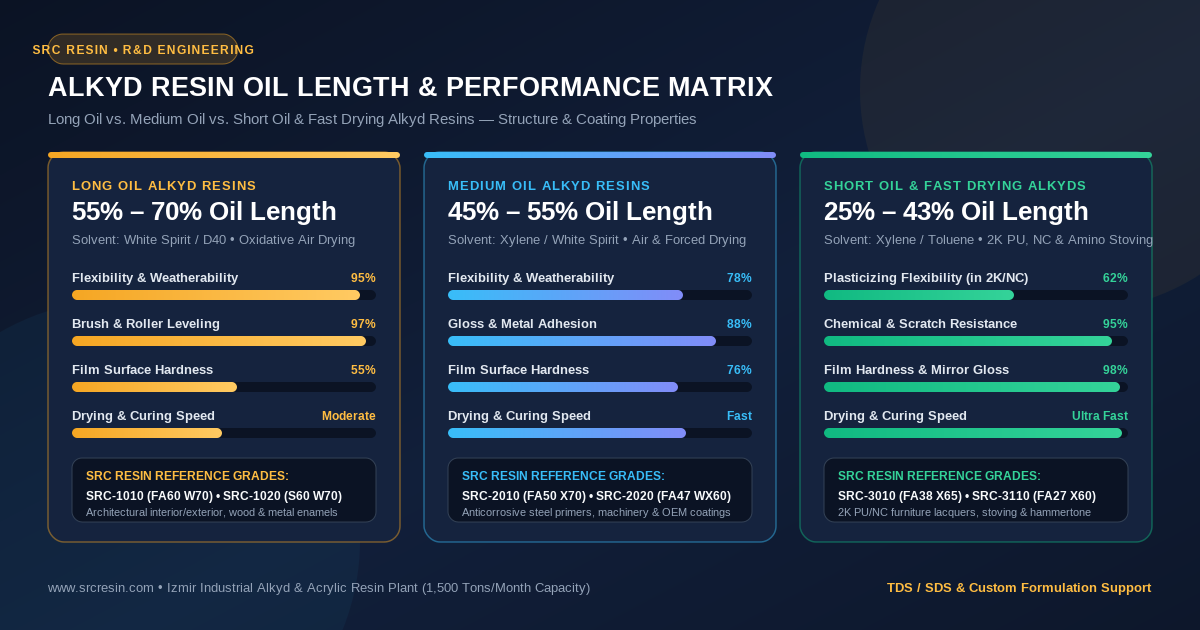
Long, Medium & Short Oil Alkyd Resin Technical Comparison Table
Key structural and coating performance parameters across alkyd resin oil-length classes.
| Parameter | Long Oil Alkyd (55–70%) | Medium Oil Alkyd (45–55%) | Short Oil Alkyd (25–43%) |
|---|---|---|---|
| Solvent Compatibility | White Spirit, D40 (Aliphatic) | Xylene / White Spirit Blend | Xylene, Toluene, Butyl Glycol (Aromatic) |
| Curing Mechanism | 1K Oxidative Air Drying | Air Drying & Forced Drying | 2K Polyurethane (NCO), Stoving (Amino) & NC |
| Film Flexibility & Weathering | Very High (Wood & Exterior Trim) | Balanced (Industrial Metal) | Medium-High (Plasticizing in 2K/NC) |
| Surface Hardness & Chemical Resistance | Moderate (Decorative Standard) | High (Anticorrosive Primers/Topcoats) | Very High (Furniture & Stoving Enamels) |
| Representative SRC Grades | SRC-1010, SRC-1020, SRC-1050 | SRC-2010, SRC-2013, SRC-2020 | SRC-3010, SRC-3030, SRC-3040 |
Recommended SRC Alkyd Resin Products for This Application
Explore our industrial alkyd resin grades manufactured at our 1,500 tons/month Izmir plant, engineered to meet the technical parameters discussed in this guide:
ALKYD FA60 W70 (Long Oil)
High-gloss long oil alkyd for interior and exterior air-drying architectural finishes and wood/metal topcoats.
ALKYD FA50 X70 (Medium Oil)
Versatile medium oil alkyd for anticorrosive primers, industrial metal coatings, and auto-repair enamels.
ALKYD FA38 X65 (Short Oil)
High-functionality short oil alkyd for 2K polyurethane wood coatings, NC lacquers, and stoving enamels.
Frequently Asked Engineering Questions
How does oil length affect the drying speed of an alkyd resin?
As oil length decreases, the phthalate ester content increases, raising the glass transition temperature (Tg) of the polymer. Short oil alkyds therefore achieve rapid physical tack-free drying upon solvent evaporation, while long oil alkyds rely on oxidative crosslinking of fatty acid double bonds.
Why are long oil alkyd resins preferred for architectural wood and metal trim paints?
Long oil alkyds (55–70% oil) provide exceptional dimensional elasticity that accommodates thermal expansion and contraction on exterior wood and metal substrates, while dissolving in low-odor aliphatic White Spirit for smooth brush and roller leveling.
Can short oil alkyd resins air-dry on their own?
Unsaturated fatty acid-based fast-drying short oil alkyds (such as SRC-3110) air-dry rapidly, whereas saturated Coconut or Castor-based non-drying short oil alkyds (such as SRC-3040) are designed to crosslink with polyisocyanates (2K PU), melamine resins (stoving), or plasticize nitrocellulose (NC).