
The Hidden Parameter That Defines Performance
One of the most underestimated parameters in alkyd resin systems is acid value.
Many drying problems, surface tackiness issues and inconsistencies in film performance observed in practice are directly related to this value, even though it is often treated as a simple laboratory figure.
In this article, I would like to explain why acid value in alkyd resins is critical and why it should be considered a key performance parameter from a manufacturer’s perspective.
What Does Acid Value Mean in Alkyd Resins?
Acid value represents the amount of free acids present in an alkyd resin.
It is an important indicator of how complete the reaction is and how balanced the resin structure will behave in real applications.
In practical terms, acid value directly influences
Drying behavior
Drier efficiency
Film formation and final hardness
What Happens When the Acid Value Is Too High?
Alkyd resins with high acid values often lead to the following issues
Extended drying time
Reduced drier efficiency
Persistent surface tackiness
Lower-than-expected film hardness
In such cases, increasing the drier dosage is often the first reaction. However, the real problem lies not in the drier amount, but in the chemical imbalance of the resin.
How Does Acid Value Affect Drier Performance?
Driers are the driving force behind oxidative curing in alkyd systems.
When the acid value is too high, driers become less effective and the curing process becomes uneven.
As a result
The surface may dry too quickly
Lower layers may remain under-cured
The film structure becomes unbalanced
This leads to application difficulties and long-term performance issues.
Is a Lower Acid Value Always Better?
Not necessarily.
An excessively low acid value may also cause problems such as
Reduced processing flexibility
Lower application tolerance
Inconsistent film formation
The key is not having the lowest acid value, but having the right acid value for the intended application.
The Manufacturer’s Perspective: The Right Approach
Acid value should never be evaluated in isolation. It must be considered together with:
Oil length
Molecular weight and distribution
Drier system compatibility
End-use application requirements
A well-designed alkyd resin is the result of a balanced chemical system, not a single optimized parameter.
Conclusion
Acid value is a silent but decisive parameter in alkyd resin performance.
Instead of trying to correct drying problems during application, achieving the correct acid value at the production stage always delivers more reliable results.
From a manufacturer’s point of view, performance does not come from one number, but from chemical balance.
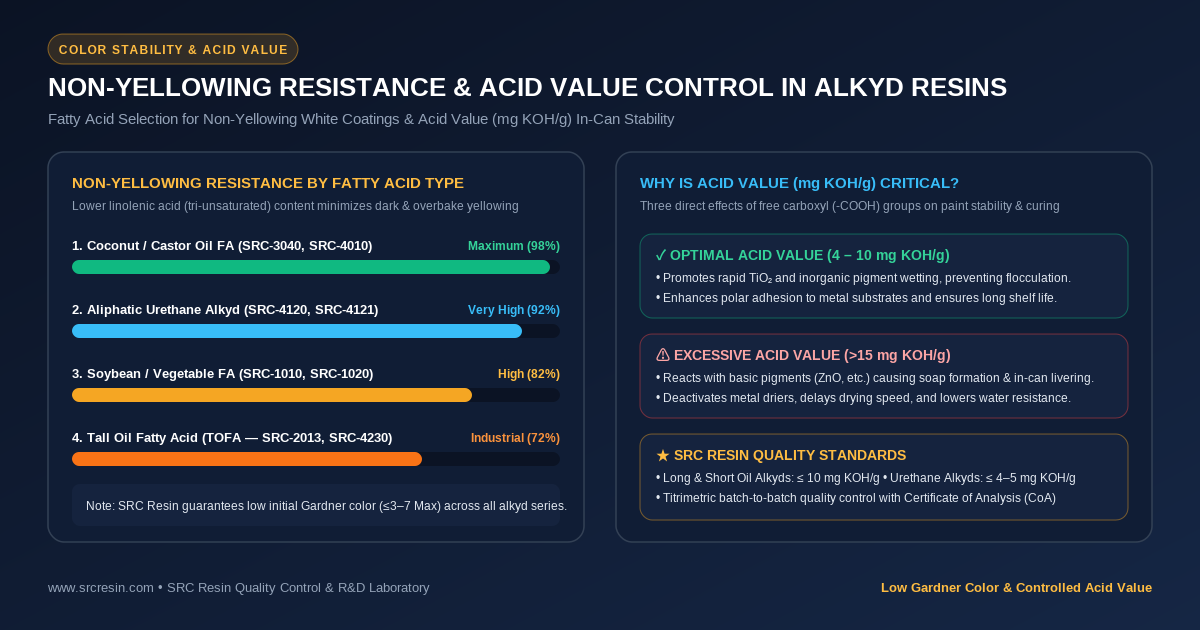
Fatty Acid Type & Acid Value vs. Non-Yellowing Stability Table
Selection guide for white architectural enamels, 2K furniture lacquers, and clear marine varnishes.
| Fatty Acid / Modification | Linolenic Acid Content | Non-Yellowing Resistance | Acid Value (mg KOH/g) | Recommended SRC Grades |
|---|---|---|---|---|
| Coconut Oil Fatty Acid | 0% (Fully Saturated) | Maximum (2K PU & Stoving Whites) | ≤ 10 Max | SRC-3040, SRC-4010, SRC-4020 |
| Aliphatic Isocyanate Urethane Alkyd | Low | Very High (1K Clear Yacht & Wood Varnish) | ≤ 5 Max | SRC-4120, SRC-4121 |
| Soybean / Distilled Vegetable FA | Low-Moderate (~5–7%) | High (Interior/Exterior Decorative White) | ≤ 10 Max | SRC-1010, SRC-1020, SRC-1040 |
| TOFA (Tall Oil Fatty Acid) | Low | Good (Industrial Primers & Machinery) | ≤ 10–13 Max | SRC-2013, SRC-4230 |
Recommended SRC Alkyd Resin Products for This Application
Explore our industrial alkyd resin grades manufactured at our 1,500 tons/month Izmir plant, engineered to meet the technical parameters discussed in this guide:
ALKYD CFA30 X70 PU (Non-Yellowing 2K PU)
Coconut-based PU-modified alkyd delivering maximum whiteness retention in high-gloss 2K furniture topcoats.
ALKYD FA60 W60 UR (Aliphatic Uralkyd)
Non-yellowing aliphatic urethane alkyd designed for marine yacht varnishes and clear wood finishes.
ALKYD CFA33 BG60 (Coconut Short Oil)
High-reactivity non-yellowing short oil alkyd for can coatings, amino stoving enamels, and 2K PU systems.
Frequently Asked Engineering Questions
Why do alkyd paints yellow in dark or indoor environments?
During oxidative crosslinking, polyunsaturated fatty acid chains (especially tri-unsaturated linolenic acid) form hydroperoxides that decompose into yellow chromophoric diketones and quinones. Without UV daylight bleaching, this chromophore buildup appears as dark yellowing.
What happens if the Acid Value (mg KOH/g) of an alkyd resin is too high?
An excessive acid value (>15 mg KOH/g) causes soap formation with basic pigments such as Zinc Oxide (ZnO), resulting in severe viscosity drift or in-can gelation (livering), delayed drying due to drier adsorption, and reduced water resistance.
Which SRC Resin grades are engineered for non-yellowing white lacquers and clear coats?
For 2K polyurethane white furniture topcoats, Coconut fatty acid-based SRC-4010 and SRC-4020 (Gardner Color ≤ 3) offer complete non-yellowing stability. For 1K air-drying clear yacht varnishes, aliphatic isocyanate-modified SRC-4120 and SRC-4121 are ideal.